


Page 190 - Science at the nanoscale
P. 190
10:16
                                                     RPS: PSP0007 - Science-at-Nanoscale
                   June 5, 2009
                              Nanotools and Nanofabrication
                         180
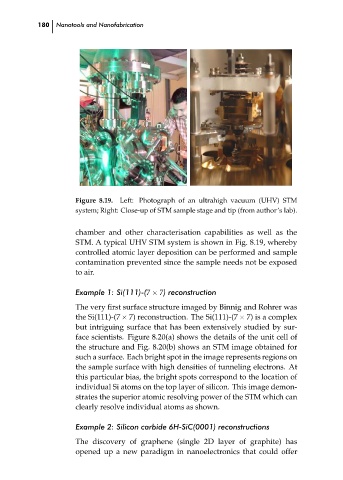
                                               Left: Photograph of an ultrahigh vacuum (UHV) STM
                                   Figure 8.19.
                                   system; Right: Close-up of STM sample stage and tip (from author’s lab).
                                   chamber and other characterisation capabilities as well as the
                                   STM. A typical UHV STM system is shown in Fig. 8.19, whereby
                                   controlled atomic layer deposition can be performed and sample
                                   contamination prevented since the sample needs not be exposed
                                   to air.
                                   Example 1: Si(111)-(7 × 7) reconstruction
                                   The very first surface structure imaged by Binnig and Rohrer was
                                   the Si(111)-(7 × 7) reconstruction. The Si(111)-(7 × 7) is a complex
                                   but intriguing surface that has been extensively studied by sur-
                                   face scientists. Figure 8.20(a) shows the details of the unit cell of  ch08
                                   the structure and Fig. 8.20(b) shows an STM image obtained for
                                   such a surface. Each bright spot in the image represents regions on
                                   the sample surface with high densities of tunneling electrons. At
                                   this particular bias, the bright spots correspond to the location of
                                   individual Si atoms on the top layer of silicon. This image demon-
                                   strates the superior atomic resolving power of the STM which can
                                   clearly resolve individual atoms as shown.
                                   Example 2: Silicon carbide 6H-SiC(0001) reconstructions
                                   The discovery of graphene (single 2D layer of graphite) has
                                   opened up a new paradigm in nanoelectronics that could offer

