


Page 192 - Science at the nanoscale
P. 192
10:16
                                                     RPS: PSP0007 - Science-at-Nanoscale
                   June 5, 2009
                              Nanotools and Nanofabrication
                         182
                                                             1100ºC
                                        850ºC + Si flux
                                            3X3
                                                                              Graphene
                                            (a)
                                                               (b)
                                                               (b)
                                                                                 (c)
                                                                                (c)
                                            (a)
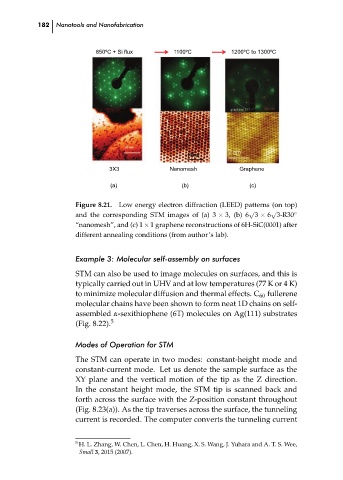
                                   Figure 8.21.
                                              Low energy electron diffraction (LEED) patterns (on top)
                                                                                      √
                                                                                √
                                   and the corresponding STM images of (a) 3 × 3, (b) 6 3 × 6 3-R30
                                   “nanomesh”, and (c) 1 × 1 graphene reconstructions of 6H-SiC(0001) after
                                   different annealing conditions (from author’s lab).
                                   Example 3: Molecular self-assembly on surfaces
                                   STM can also be used to image molecules on surfaces, and this is
                                   typically carried out in UHV and at low temperatures (77 K or 4 K)
                                   to minimize molecular diffusion and thermal effects. C 60 fullerene
                                   molecular chains have been shown to form neat 1D chains on self-
                                   assembled α-sexithiophene (6T) molecules on Ag(111) substrates
                                            5
                                   (Fig. 8.22).
                                   Modes of Operation for STM Nanomesh     1200ºC to 1300ºC  ◦     ch08
                                   The STM can operate in two modes: constant-height mode and
                                   constant-current mode. Let us denote the sample surface as the
                                   XY plane and the vertical motion of the tip as the Z direction.
                                   In the constant height mode, the STM tip is scanned back and
                                   forth across the surface with the Z-position constant throughout
                                   (Fig. 8.23(a)). As the tip traverses across the surface, the tunneling
                                   current is recorded. The computer converts the tunneling current
                                   5  H. L. Zhang, W. Chen, L. Chen, H. Huang, X. S. Wang, J. Yuhara and A. T. S. Wee,
                                    Small 3, 2015 (2007).

