


Page 197 - Science at the nanoscale
P. 197
RPS: PSP0007 - Science-at-Nanoscale
                             10:16
                   June 5, 2009
                                                                    8.3. Scanning Probe Microscopy
                                            Laser
                                                 Controller
                                    Detector
                                                 electronics
                                    electronics
                                           Scanner
                                    Photo-
                                    detector
                                             X, Y
                                             Z
                                                  Piezo
                                              Tip
                                            Sample
                                              (a)
                                                                   (b)
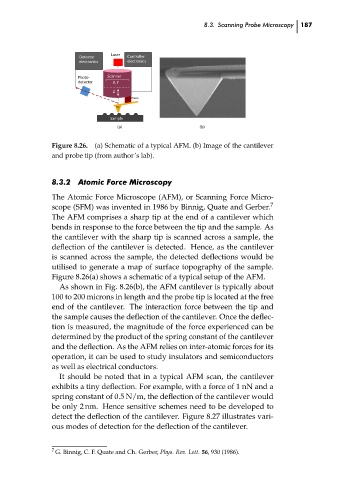
                             Figure 8.26.
                                        (a) Schematic of a typical AFM. (b) Image of the cantilever
                             and probe tip (from author’s lab).
                             8.3.2
                                    Atomic Force Microscopy
                             The Atomic Force Microscope (AFM), or Scanning Force Micro-
                             scope (SFM) was invented in 1986 by Binnig, Quate and Gerber.
                             The AFM comprises a sharp tip at the end of a cantilever which
                             bends in response to the force between the tip and the sample. As
                             the cantilever with the sharp tip is scanned across a sample, the
                             deflection of the cantilever is detected. Hence, as the cantilever
                             is scanned across the sample, the detected deflections would be
                             utilised to generate a map of surface topography of the sample.
                             Figure 8.26(a) shows a schematic of a typical setup of the AFM.
                               As shown in Fig. 8.26(b), the AFM cantilever is typically about
                             100 to 200 microns in length and the probe tip is located at the free
                             end of the cantilever. The interaction force between the tip and
                             the sample causes the deflection of the cantilever. Once the deflec-
                             tion is measured, the magnitude of the force experienced can be
                             determined by the product of the spring constant of the cantilever 7  187  ch08
                             and the deflection. As the AFM relies on inter-atomic forces for its
                             operation, it can be used to study insulators and semiconductors
                             as well as electrical conductors.
                               It should be noted that in a typical AFM scan, the cantilever
                             exhibits a tiny deflection. For example, with a force of 1 nN and a
                             spring constant of 0.5 N/m, the deflection of the cantilever would
                             be only 2 nm. Hence sensitive schemes need to be developed to
                             detect the deflection of the cantilever. Figure 8.27 illustrates vari-
                             ous modes of detection for the deflection of the cantilever.
                             7  G. Binnig, C. F. Quate and Ch. Gerber, Phys. Rev. Lett. 56, 930 (1986).

