


Page 198 - Science at the nanoscale
P. 198
10:16
                   June 5, 2009
                              Nanotools and Nanofabrication
                         188
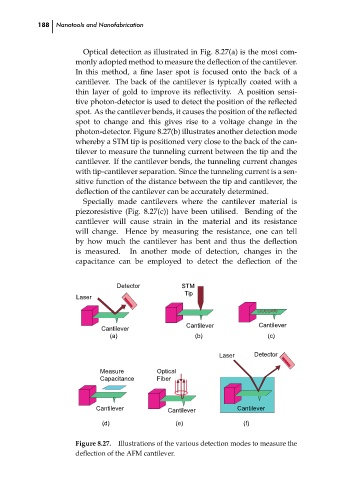
                                     Optical detection as illustrated in Fig. 8.27(a) is the most com-
                                   monly adopted method to measure the deflection of the cantilever.
                                   In this method, a fine laser spot is focused onto the back of a
                                   cantilever. The back of the cantilever is typically coated with a
                                   thin layer of gold to improve its reflectivity. A position sensi-
                                   tive photon-detector is used to detect the position of the reflected
                                   spot. As the cantilever bends, it causes the position of the reflected
                                   spot to change and this gives rise to a voltage change in the
                                   photon-detector. Figure 8.27(b) illustrates another detection mode
                                   whereby a STM tip is positioned very close to the back of the can-
                                   tilever to measure the tunneling current between the tip and the
                                   cantilever. If the cantilever bends, the tunneling current changes
                                   with tip-cantilever separation. Since the tunneling current is a sen-
                                   sitive function of the distance between the tip and cantilever, the
                                   deflection of the cantilever can be accurately determined.
                                     Specially made cantilevers where the cantilever material is
                                   piezoresistive (Fig. 8.27(c)) have been utilised. Bending of the
                                   cantilever will cause strain in the material and its resistance
                                   will change. Hence by measuring the resistance, one can tell
                                   by how much the cantilever has bent and thus the deflection
                                   is measured.
                                                 In another mode of detection, changes in the
                                   capacitance can be employed to detect the deflection of the
                                                               STM
                                                               Tip
                                   Laser
                                                                Cantilever
                                          Cantilever
                                            (a) Detector  RPS: PSP0007 - Science-at-Nanoscale  Cantilever  ch08
                                                                                     (c)
                                                                  (b)
                                                                        Laser    Detector
                                         Measure        Optical
                                         Capacitance    Fiber
                                        Cantilever         Cantilever        Cantilever
                                          (d)                (e)               (f)
                                   Figure 8.27.  Illustrations of the various detection modes to measure the
                                   deflection of the AFM cantilever.

