


Page 203 - Science at the nanoscale
P. 203
RPS: PSP0007 - Science-at-Nanoscale
                             10:16
                   June 5, 2009
                                                                            8.4. Optical Tweezers
                                (a)
                                                                    (b)
                                                     Laser Beam
                                Fluid Flow
                                                       Objective Lens
                                                        Trapped
                                                        Microsphere
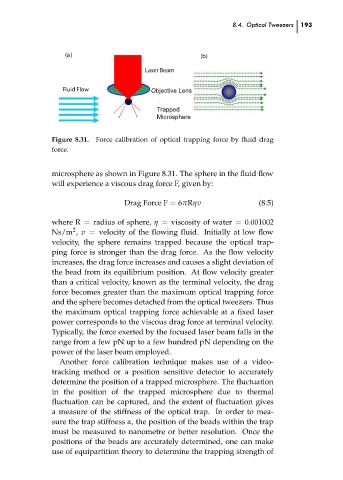
                                        Force calibration of optical trapping force by fluid drag
                             Figure 8.31.
                             force.
                             microsphere as shown in Figure 8.31. The sphere in the fluid flow
                             will experience a viscous drag force F, given by:
                                                                                   (8.5)
                                                Drag Force F = 6πRηv
                             where R = radius of sphere, η = viscosity of water = 0.001002
                                  2
                             Ns/m , v = velocity of the flowing fluid. Initially at low flow
                             velocity, the sphere remains trapped because the optical trap-
                             ping force is stronger than the drag force. As the flow velocity
                             increases, the drag force increases and causes a slight deviation of
                             the bead from its equilibrium position. At flow velocity greater
                             than a critical velocity, known as the terminal velocity, the drag
                             force becomes greater than the maximum optical trapping force
                             and the sphere becomes detached from the optical tweezers. Thus
                             the maximum optical trapping force achievable at a fixed laser
                             power corresponds to the viscous drag force at terminal velocity.
                             Typically, the force exerted by the focused laser beam falls in the
                             range from a few pN up to a few hundred pN depending on the     193   ch08
                             power of the laser beam employed.
                               Another force calibration technique makes use of a video-
                             tracking method or a position sensitive detector to accurately
                             determine the position of a trapped microsphere. The fluctuation
                             in the position of the trapped microsphere due to thermal
                             fluctuation can be captured, and the extent of fluctuation gives
                             a measure of the stiffness of the optical trap. In order to mea-
                             sure the trap stiffness α, the position of the beads within the trap
                             must be measured to nanometre or better resolution. Once the
                             positions of the beads are accurately determined, one can make
                             use of equipartition theory to determine the trapping strength of

