


Page 204 - Science at the nanoscale
P. 204
10:16
                                                     RPS: PSP0007 - Science-at-Nanoscale
                   June 5, 2009
                              Nanotools and Nanofabrication
                         194
                                   the optical tweezers. Accordingly,
                                                         1
                                                                     2
                                                          k B T =
                                                                 2
                                                         2
                                   where x is the displacement of the particle from its trapped equi-
                                   librium position, α is the stiffness, k B is the Boltzmann constant
                                   and T is the temperature of the system.
                                     Since the advent of the optical tweezers, different methods have
                                   been employed to shape the laser beam into different configu-
                                   rations for the purpose of optical trapping of assemblies of col-
                                   loidal particles. These optical traps provide an important tool in
                                   the mesoscopic environment to trap and manipulate microscopic
                                   objects. Patterned laser beams have also been developed for many
                                   purposes such as the assembly of polymerised colloidal structure
                                   into micro-fluidic devices, driving forces for micro-devices and for
                                   cell-manipulation. One commonly adopted technique to create an
                                   array of laser spots is to use a diffractive optical element. Other
                                   techniques include the use of galvanometer scanning mirrors or
                                   a piezoelectric scanning mirror, computer-generated holograms
                                   and acoustically modulated light beams. Examples of optical trap-
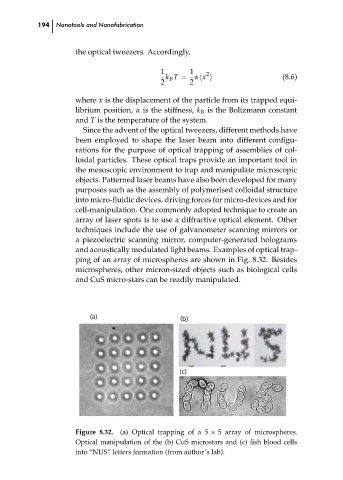
                                   ping of an array of microspheres are shown in Fig. 8.32. Besides
                                   microspheres, other micron-sized objects such as biological cells
                                   and CuS micro-stars can be readily manipulated.
                                       (a)
                                                              (b)
                                                              (c)  1  αhx i              (8.6)     ch08
                                   Figure 8.32.  (a) Optical trapping of a 5 × 5 array of microspheres.
                                   Optical manipulation of the (b) CuS microstars and (c) fish blood cells
                                   into “NUS” letters formation (from author’s lab).

