


Page 206 - Science at the nanoscale
P. 206
10:16
                                                     RPS: PSP0007 - Science-at-Nanoscale
                   June 5, 2009
                              Nanotools and Nanofabrication
                         196
                                                                           (b)
                                                   ccd camera
                                       TV Monitor
                                                          s: Beam Splitter
                                                          L: Lens
                                               M
                                                          M: Mirror
                                                      S
                                                          optical
                                     He-Ne Laser
                                                          Microscope
                                                M
                                                                           (c)
                                                                     L
                                                       L
                                                  Sample Stage
                                                          Carbon Nanotubes on Silicon
                                    Carbon Nanotubes on Silicon
                                                             (mounted Sideway)
                                      (mounted face-up)
                                                    (a)
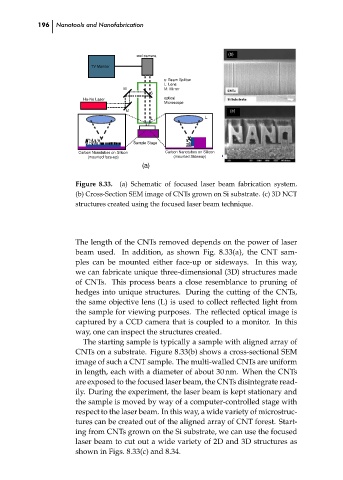
                                   Figure 8.33.
                                              (a) Schematic of focused laser beam fabrication system.
                                   (b) Cross-Section SEM image of CNTs grown on Si substrate. (c) 3D NCT
                                   structures created using the focused laser beam technique.
                                   The length of the CNTs removed depends on the power of laser
                                   beam used. In addition, as shown Fig. 8.33(a), the CNT sam-
                                   ples can be mounted either face-up or sideways. In this way,
                                   we can fabricate unique three-dimensional (3D) structures made
                                   of CNTs. This process bears a close resemblance to pruning of
                                   hedges into unique structures. During the cutting of the CNTs,
                                   the same objective lens (L) is used to collect reflected light from
                                   the sample for viewing purposes. The reflected optical image is
                                   captured by a CCD camera that is coupled to a monitor. In this
                                   way, one can inspect the structures created.
                                     The starting sample is typically a sample with aligned array of  ch08
                                   CNTs on a substrate. Figure 8.33(b) shows a cross-sectional SEM
                                   image of such a CNT sample. The multi-walled CNTs are uniform
                                   in length, each with a diameter of about 30 nm. When the CNTs
                                   are exposed to the focused laser beam, the CNTs disintegrate read-
                                   ily. During the experiment, the laser beam is kept stationary and
                                   the sample is moved by way of a computer-controlled stage with
                                   respect to the laser beam. In this way, a wide variety of microstruc-
                                   tures can be created out of the aligned array of CNT forest. Start-
                                   ing from CNTs grown on the Si substrate, we can use the focused
                                   laser beam to cut out a wide variety of 2D and 3D structures as
                                   shown in Figs. 8.33(c) and 8.34.

