


Page 196 - Science at the nanoscale
P. 196
10:16
                                                     RPS: PSP0007 - Science-at-Nanoscale
                   June 5, 2009
                              Nanotools and Nanofabrication
                         186
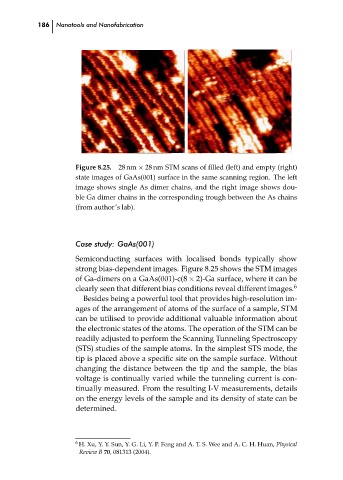
                                              28 nm × 28 nm STM scans of filled (left) and empty (right)
                                   Figure 8.25.
                                   state images of GaAs(001) surface in the same scanning region. The left
                                   image shows single As dimer chains, and the right image shows dou-
                                   ble Ga dimer chains in the corresponding trough between the As chains
                                   (from author’s lab).
                                   Case study: GaAs(001)
                                   Semiconducting surfaces with localised bonds typically show
                                   strong bias-dependent images. Figure 8.25 shows the STM images
                                   of Ga-dimers on a GaAs(001)-c(8 × 2)-Ga surface, where it can be
                                   clearly seen that different bias conditions reveal different images.
                                     Besides being a powerful tool that provides high-resolution im-
                                   ages of the arrangement of atoms of the surface of a sample, STM
                                   can be utilised to provide additional valuable information about
                                   the electronic states of the atoms. The operation of the STM can be
                                   readily adjusted to perform the Scanning Tunneling Spectroscopy 6  ch08
                                   (STS) studies of the sample atoms. In the simplest STS mode, the
                                   tip is placed above a specific site on the sample surface. Without
                                   changing the distance between the tip and the sample, the bias
                                   voltage is continually varied while the tunneling current is con-
                                   tinually measured. From the resulting I-V measurements, details
                                   on the energy levels of the sample and its density of state can be
                                   determined.
                                   6  H. Xu, Y. Y. Sun, Y. G. Li, Y. P. Feng and A. T. S. Wee and A. C. H. Huan, Physical
                                    Review B 70, 081313 (2004).

