


Page 75 - Science at the nanoscale
P. 75
RPS: PSP0007 - Science-at-Nanoscale
                             7:6
                   June 12, 2009
                                                             4.2. Molecules and Molecular Interactions
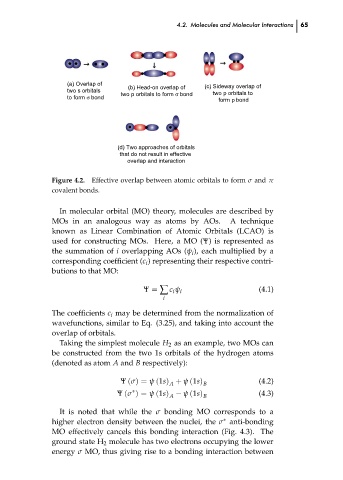
                                 (a) Overlap of
                                                 (b) Head-on overlap of
                                 two s orbitals
                                                                       two p orbitals to
                                               two p orbitals to form σ bond
                                 to form σ bond
                                                                        form p bond
                                               that do not result in effective
                                                 overlap and interaction
                             Figure 4.2. Effective overlap between atomic orbitals to form σ and π
                             covalent bonds.
                               In molecular orbital (MO) theory, molecules are described by
                                                                           A technique
                             MOs in an analogous way as atoms by AOs.
                             known as Linear Combination of Atomic Orbitals (LCAO) is
                             used for constructing MOs. Here, a MO (Ψ) is represented as
                             the summation of i overlapping AOs (ψ ), each multiplied by a
                             corresponding coefficient (c ) representing their respective contri-
                                                     i
                             butions to that MO:
                                                           c
                                                         ∑ i ψ i
                                                     Ψ =
                                                          i
                             The coefficients c may be determined from the normalization of
                                            i
                             wavefunctions, similar to Eq. (3.25), and taking into account the
                             overlap of orbitals.  (d) Two approaches of orbitals i  (c) Sideway overlap of (4.1)  65  ch04
                               Taking the simplest molecule H 2 as an example, two MOs can
                             be constructed from the two 1s orbitals of the hydrogen atoms
                             (denoted as atom A and B respectively):
                                               Ψ (σ) = ψ (1s) + ψ (1s) B           (4.2)
                                                           A
                                                  ∗
                                              Ψ (σ ) = ψ (1s) − ψ (1s) B           (4.3)
                                                           A
                               It is noted that while the σ bonding MO corresponds to a
                             higher electron density between the nuclei, the σ anti-bonding
                                                                         ∗
                             MO effectively cancels this bonding interaction (Fig. 4.3). The
                             ground state H 2 molecule has two electrons occupying the lower
                             energy σ MO, thus giving rise to a bonding interaction between

