


Page 79 - Science at the nanoscale
P. 79
7:6
                                                     RPS: PSP0007 - Science-at-Nanoscale
                   June 12, 2009
                                                             4.2. Molecules and Molecular Interactions
                             we say that the Cl atom is more electronegative than the H atom
                             and that the HCl molecule is polar. In the MOs constructed, the
                             respective coefficients (c i in Eq. 4.1) will reflect the uneven contri-
                             butions of the respective AOs. For example, the bonding orbital
                                                              5
                             of HCl may be empirically written as :
                                                                                   (4.6)
                                           Ψ (σ) = 0.57ψ (1s) + 0.73ψ (2p)
                                                           H
                                                                       Cl
                             Since the electron probability density is given by the square of
                             the wave function coefficient, we estimate that the bonding elec-
                                                      2
                                                            2
                                              2
                             trons spend ∼ 0.73 ÷ (0.57 + 0.73 ) = 62% of their time at the
                             Cl atom. For the extreme situation when the bonding electrons
                             are distributed ∼100% over one atom rather than the other, the
                             molecule may be more appropriately described as A B . The
                                                                             + −
                             ionic bond thus formed may then be ascribed to the Coulombic
                             force of attraction between the two ions.
                             4.2.2
                                    Dipole Moment
                             Classically, two equal but opposite charges +δ and −δ separated
                             by a distance l produce a dipole moment µ given as:
                                                      µ = δ × l
                                                                                   (4.7)
                             This is a vector quantity and the direction of the moment is often
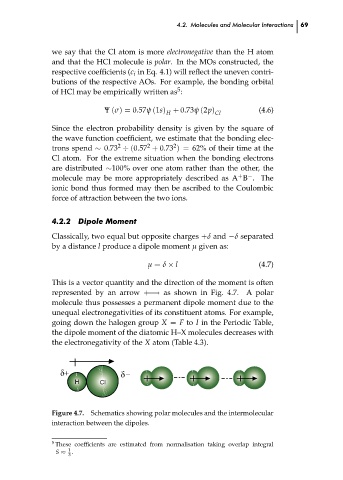
                             represented by an arrow +−→ as shown in Fig. 4.7. A polar
                             molecule thus possesses a permanent dipole moment due to the
                             unequal electronegativities of its constituent atoms. For example,
                             going down the halogen group X = F to I in the Periodic Table,
                             the dipole moment of the diatomic H–X molecules decreases with  69    ch04
                             the electronegativity of the X atom (Table 4.3).
                               į+              į _
                                   H     Cl
                             Figure 4.7. Schematics showing polar molecules and the intermolecular
                             interaction between the dipoles.
                             5  These coefficients are estimated from normalisation taking overlap integral
                                 1
                              S ≈ .
                                 3

