


Page 78 - Science at the nanoscale
P. 78
7:6
                                                     RPS: PSP0007 - Science-at-Nanoscale
                   June 12, 2009
                              From Atoms and Molecules to Nanoscale Materials
                          68
                                         z
                                                        z
                                                                      z
                                                                                         y
                                                            y
                                              y
                                                                             x
                                                x
                                                                                           x
                                         s
                                                                      p
                                                       p
                                                        x
                                                                      y
                                                         Combined to generate
                                                             3
                                                         four sp hybrid orbitals
                                                                            3
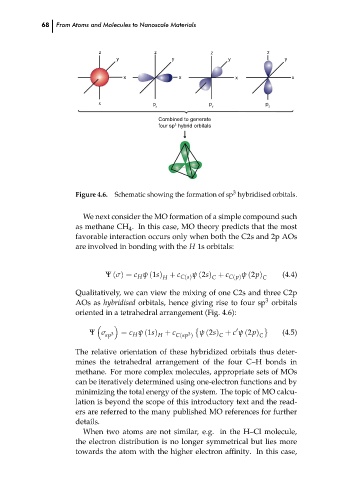
                                   Figure 4.6.
                                             Schematic showing the formation of sp hybridised orbitals.
                                     We next consider the MO formation of a simple compound such
                                   as methane CH 4 . In this case, MO theory predicts that the most
                                   favorable interaction occurs only when both the C2s and 2p AOs
                                   are involved in bonding with the H 1s orbitals:
                                                          H
                                                                       C
                                   Qualitatively, we can view the mixing of one C2s and three C2p
                                   AOs as hybridised orbitals, hence giving rise to four sp orbitals
                                   oriented in a tetrahedral arrangement (Fig. 4.6):


                                                                             ′

                                               = c H ψ (1s) + c
                                                                                         (4.5)
                                       Ψ σ Ψ (σ) = c H ψ (1s) + c x C(s) 3  ψ (2s) + c y C(p)  ψ (2p) C C 	 p 3 z z  (4.4)  ch04
                                                                   ψ (2s) + c ψ (2p)
                                            3
                                           sp
                                                                        C
                                                        H
                                                             C(sp )
                                   The relative orientation of these hybridized orbitals thus deter-
                                   mines the tetrahedral arrangement of the four C–H bonds in
                                   methane. For more complex molecules, appropriate sets of MOs
                                   can be iteratively determined using one-electron functions and by
                                   minimizing the total energy of the system. The topic of MO calcu-
                                   lation is beyond the scope of this introductory text and the read-
                                   ers are referred to the many published MO references for further
                                   details.
                                     When two atoms are not similar, e.g. in the H–Cl molecule,
                                   the electron distribution is no longer symmetrical but lies more
                                   towards the atom with the higher electron affinity. In this case,

