


Page 80 - Science at the nanoscale
P. 80
7:6
                                                     RPS: PSP0007 - Science-at-Nanoscale
                   June 12, 2009
                              From Atoms and Molecules to Nanoscale Materials
                          70
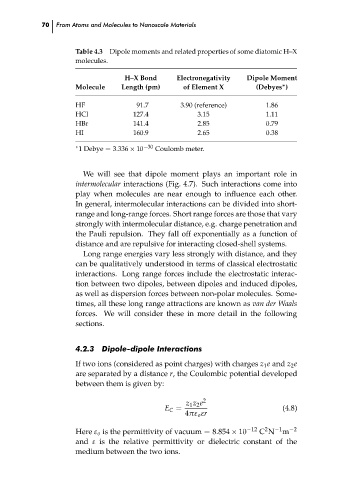
                                   Table 4.3 Dipole moments and related properties of some diatomic H–X
                                   molecules.
                                                             Electronegativity
                                                H–X Bond
                                               Length (pm)
                                                               of Element X
                                                                                         ∗
                                   Molecule
                                                                                  (Debyes )
                                                              3.90 (reference)
                                                   91.7
                                                                                     1.86
                                   HF
                                                  127.4
                                                                   3.15
                                   HCl
                                                                                     1.11
                                                                                     0.79
                                                                   2.85
                                   HBr
                                                  141.4
                                                                                     0.38
                                                  160.9
                                   HI
                                                                   2.65
                                                     −30
                                    1 Debye = 3.336 × 10
                                                        Coulomb meter.
                                   ∗
                                     We will see that dipole moment plays an important role in
                                   intermolecular interactions (Fig. 4.7). Such interactions come into
                                   play when molecules are near enough to influence each other.
                                   In general, intermolecular interactions can be divided into short-
                                   range and long-range forces. Short range forces are those that vary
                                   strongly with intermolecular distance, e.g. charge penetration and
                                   the Pauli repulsion. They fall off exponentially as a function of
                                   distance and are repulsive for interacting closed-shell systems.
                                     Long range energies vary less strongly with distance, and they
                                   can be qualitatively understood in terms of classical electrostatic
                                   interactions. Long range forces include the electrostatic interac-
                                   tion between two dipoles, between dipoles and induced dipoles,
                                   as well as dispersion forces between non-polar molecules. Some-
                                   times, all these long range attractions are known as van der Waals
                                   forces. We will consider these in more detail in the following
                                   sections.
                                   4.2.3  Dipole-dipole Interactions            Dipole Moment      ch04
                                   If two ions (considered as point charges) with charges z 1 e and z 2 e
                                   are separated by a distance r, the Coulombic potential developed
                                   between them is given by:
                                                                z 1 z 2 e 2
                                                          E C =                          (4.8)
                                                               4πε o εr
                                                                                    2
                                   Here ε o is the permittivity of vacuum = 8.854 × 10 −12  C N −1 m −2
                                   and ε is the relative permittivity or dielectric constant of the
                                   medium between the two ions.

