


Page 85 - Science at the nanoscale
P. 85
7:6
                                                     RPS: PSP0007 - Science-at-Nanoscale
                   June 12, 2009
                                                             4.2. Molecules and Molecular Interactions
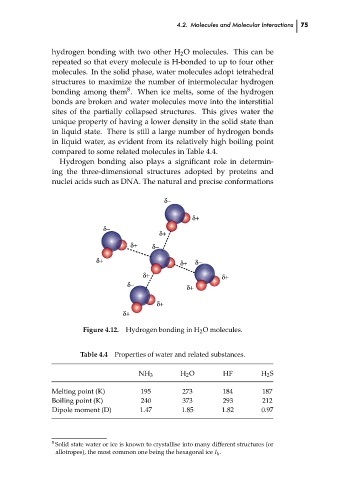
                             hydrogen bonding with two other H 2 O molecules. This can be
                             repeated so that every molecule is H-bonded to up to four other
                             molecules. In the solid phase, water molecules adopt tetrahedral
                             structures to maximize the number of intermolecular hydrogen
                                                8
                             bonding among them . When ice melts, some of the hydrogen
                             bonds are broken and water molecules move into the interstitial
                             sites of the partially collapsed structures. This gives water the
                             unique property of having a lower density in the solid state than
                             in liquid state. There is still a large number of hydrogen bonds
                             in liquid water, as evident from its relatively high boiling point
                             compared to some related molecules in Table 4.4.
                               Hydrogen bonding also plays a significant role in determin-
                             ing the three-dimensional structures adopted by proteins and
                             nuclei acids such as DNA. The natural and precise conformations
                                                          δ−
                                                                 δ+
                                          δ−
                                                         δ+
                                                 δ+
                                                       δ−
                                        δ+
                                                                  δ−
                                                              δ+
                                                     δ+
                                                                         δ+
                                                δ−
                                                                δ+
                                                        δ+
                                               δ+
                                                Hydrogen bonding in H 2 O molecules.
                                     Figure 4.12.
                                    Table 4.4 Properties of water and related substances.    75    ch04
                                                   NH 3       H 2 O      HF        H 2 S
                             Melting point (K)      195        273       184        187
                             Boiling point (K)      240        373       293        212
                             Dipole moment (D)      1.47       1.85      1.82      0.97
                             8  Solid state water or ice is known to crystallise into many different structures (or
                              allotropes), the most common one being the hexagonal ice I h .

