


Page 89 - Science at the nanoscale
P. 89
7:6
                                                     RPS: PSP0007 - Science-at-Nanoscale
                   June 12, 2009
                                                                   4.3. From Atoms to Solid Materials
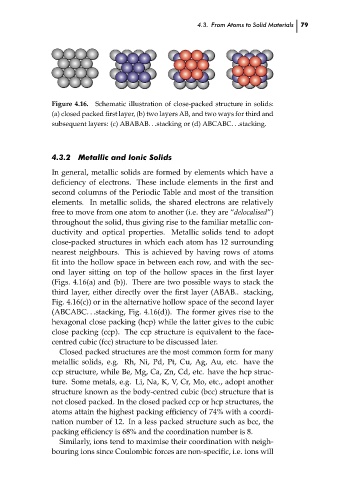
                             Figure 4.16.
                                        Schematic illustration of close-packed structure in solids:
                             (a) closed packed first layer, (b) two layers AB, and two ways for third and
                             subsequent layers: (c) ABABAB. . .stacking or (d) ABCABC. . .stacking.
                             4.3.2
                                    Metallic and Ionic Solids
                             In general, metallic solids are formed by elements which have a
                             deficiency of electrons. These include elements in the first and
                             second columns of the Periodic Table and most of the transition
                             elements. In metallic solids, the shared electrons are relatively
                             free to move from one atom to another (i.e. they are “delocalised”)
                             throughout the solid, thus giving rise to the familiar metallic con-
                             ductivity and optical properties. Metallic solids tend to adopt
                             close-packed structures in which each atom has 12 surrounding
                             nearest neighbours. This is achieved by having rows of atoms
                             fit into the hollow space in between each row, and with the sec-
                             ond layer sitting on top of the hollow spaces in the first layer
                             (Figs. 4.16(a) and (b)). There are two possible ways to stack the
                             third layer, either directly over the first layer (ABAB.. stacking,
                             Fig. 4.16(c)) or in the alternative hollow space of the second layer
                             (ABCABC. . .stacking, Fig. 4.16(d)). The former gives rise to the
                             hexagonal close packing (hcp) while the latter gives to the cubic
                             close packing (ccp). The ccp structure is equivalent to the face-
                             centred cubic (fcc) structure to be discussed later.            79    ch04
                               Closed packed structures are the most common form for many
                             metallic solids, e.g. Rh, Ni, Pd, Pt, Cu, Ag, Au, etc. have the
                             ccp structure, while Be, Mg, Ca, Zn, Cd, etc. have the hcp struc-
                             ture. Some metals, e.g. Li, Na, K, V, Cr, Mo, etc., adopt another
                             structure known as the body-centred cubic (bcc) structure that is
                             not closed packed. In the closed packed ccp or hcp structures, the
                             atoms attain the highest packing efficiency of 74% with a coordi-
                             nation number of 12. In a less packed structure such as bcc, the
                             packing efficiency is 68% and the coordination number is 8.
                               Similarly, ions tend to maximise their coordination with neigh-
                             bouring ions since Coulombic forces are non-specific, i.e. ions will

