


Page 86 - Science at the nanoscale
P. 86
7:6
                   June 12, 2009
                              From Atoms and Molecules to Nanoscale Materials
                          76
                                                                            O
                                                                     H
                                                                  O
                                                                        R
                                                                     N
                                                                          N
                                                                N
                                                                          ... H
                                                                ... H
                                                                       O
                                                                   R
                                                                       ...
                                                                O
                                                                    R
                                                                       H
                                                                          O
                                                                       N
                                                                  N
                                                                            N
                                                                  H
                                                                            H
                                                                     O
                                                                         R
                                                                      beta-pleated sheets
                                                               alpha helix
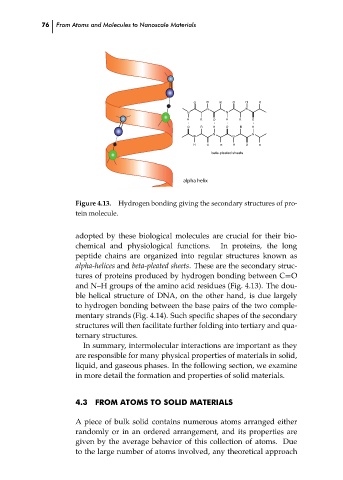
                                   Figure 4.13.
                                              Hydrogen bonding giving the secondary structures of pro-
                                   tein molecule.
                                   adopted by these biological molecules are crucial for their bio-
                                                                         In proteins, the long
                                   chemical and physiological functions.
                                   peptide chains are organized into regular structures known as
                                   alpha-helices and beta-pleated sheets. These are the secondary struc-
                                   tures of proteins produced by hydrogen bonding between C=O
                                   and N–H groups of the amino acid residues (Fig. 4.13). The dou-
                                   ble helical structure of DNA, on the other hand, is due largely
                                   to hydrogen bonding between the base pairs of the two comple-
                                   mentary strands (Fig. 4.14). Such specific shapes of the secondary
                                   structures will then facilitate further folding into tertiary and qua-
                                   ternary structures.  RPS: PSP0007 - Science-at-Nanoscale  R R  H N O  O H N ...  R R  ch04
                                     In summary, intermolecular interactions are important as they
                                   are responsible for many physical properties of materials in solid,
                                   liquid, and gaseous phases. In the following section, we examine
                                   in more detail the formation and properties of solid materials.
                                   4.3 FROM ATOMS TO SOLID MATERIALS
                                   A piece of bulk solid contains numerous atoms arranged either
                                   randomly or in an ordered arrangement, and its properties are
                                   given by the average behavior of this collection of atoms. Due
                                   to the large number of atoms involved, any theoretical approach

