


Page 87 - Science at the nanoscale
P. 87
7:6
                                                     RPS: PSP0007 - Science-at-Nanoscale
                   June 12, 2009
                                                                   4.3. From Atoms to Solid Materials
                                                                 H
                                          A
                                     T
                                                                   N
                                                                            O
                                                                      H
                                                            N
                                     C
                                            G
                                      A
                                            T
                                                         N
                                                                  N
                                                                         H
                                                                            N
                                            C
                                         G
                                      Sugar Phosphate
                                                                                 N
                                                              N
                                             G
                                         C
                                                                            O
                                                         Adenine
                                     A
                                                                             Thymine
                                             T
                                           C
                                    G
                                      Sugar Phosphate
                                                                              H
                                        A
                                    T
                                                                   O
                                                                         H
                                                                            N
                                                            N
                                    A
                                         T
                                     G
                                            C
                                                         N
                                                                  N
                                                                      H
                                                                            N
                                       T
                                             A
                                                                                 N
                                                              N
                                             G
                                         C
                                      Sugar Phosphate
                                                                            O
                                                                      H
                                                                   N
                                             C
                                         G
                                                                 H
                                                                             Cytosine
                                                        Guanine
                                      A
                                             T
                                           G
                                     C
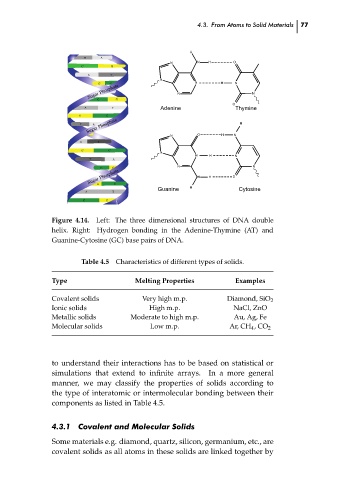
                             Figure 4.14.
                                        Left: The three dimensional structures of DNA double
                             helix. Right: Hydrogen bonding in the Adenine-Thymine (AT) and
                             Guanine-Cytosine (GC) base pairs of DNA.
                                     Table 4.5 Characteristics of different types of solids.
                             Type
                                                                             Examples
                                                   Melting Properties
                                                    Very high m.p.
                             Covalent solids
                                                                          Diamond, SiO 2
                                                      High m.p.
                             Ionic solids
                                                                            NaCl, ZnO
                                                 Moderate to high m.p.
                                                                            Au, Ag, Fe
                             Metallic solids
                             Molecular solids
                                                      Low m.p.
                                                                           Ar, CH 4 , CO 2
                             to understand their interactions has to be based on statistical or  77  ch04
                             simulations that extend to infinite arrays.  In a more general
                             manner, we may classify the properties of solids according to
                             the type of interatomic or intermolecular bonding between their
                             components as listed in Table 4.5.
                             4.3.1  Covalent and Molecular Solids
                             Some materials e.g. diamond, quartz, silicon, germanium, etc., are
                             covalent solids as all atoms in these solids are linked together by

