


Page 92 - Science at the nanoscale
P. 92
7:6
                                                     RPS: PSP0007 - Science-at-Nanoscale
                   June 12, 2009
                              From Atoms and Molecules to Nanoscale Materials
                          82
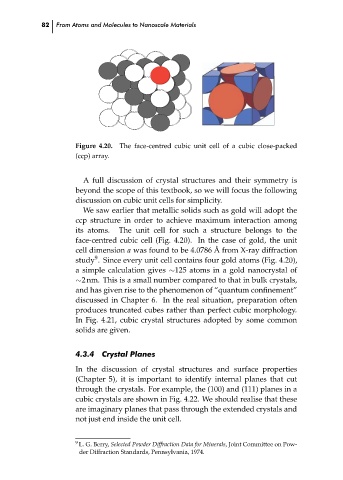
                                              The face-centred cubic unit cell of a cubic close-packed
                                   Figure 4.20.
                                   (ccp) array.
                                     A full discussion of crystal structures and their symmetry is
                                   beyond the scope of this textbook, so we will focus the following
                                   discussion on cubic unit cells for simplicity.
                                     We saw earlier that metallic solids such as gold will adopt the
                                   ccp structure in order to achieve maximum interaction among
                                   its atoms.
                                              The unit cell for such a structure belongs to the
                                   face-centred cubic cell (Fig. 4.20). In the case of gold, the unit
                                   cell dimension a was found to be 4.0786 ˚ A from X-ray diffraction
                                   study . Since every unit cell contains four gold atoms (Fig. 4.20),
                                   a simple calculation gives ∼125 atoms in a gold nanocrystal of
                                   ∼2 nm. This is a small number compared to that in bulk crystals,
                                   and has given rise to the phenomenon of “quantum confinement”
                                   discussed in Chapter 6. In the real situation, preparation often
                                   produces truncated cubes rather than perfect cubic morphology.
                                   In Fig. 4.21, cubic crystal structures adopted by some common
                                   solids are given.
                                   4.3.4 9  Crystal Planes                                         ch04
                                   In the discussion of crystal structures and surface properties
                                   (Chapter 5), it is important to identify internal planes that cut
                                   through the crystals. For example, the (100) and (111) planes in a
                                   cubic crystals are shown in Fig. 4.22. We should realise that these
                                   are imaginary planes that pass through the extended crystals and
                                   not just end inside the unit cell.
                                   9  L. G. Berry, Selected Powder Diffraction Data for Minerals, Joint Committee on Pow-
                                    der Diffraction Standards, Pennsylvania, 1974.

