


Page 88 - Science at the nanoscale
P. 88
7:6
                                                     RPS: PSP0007 - Science-at-Nanoscale
                   June 12, 2009
                              From Atoms and Molecules to Nanoscale Materials
                          78
                                                 (a)
                                                                               (b)
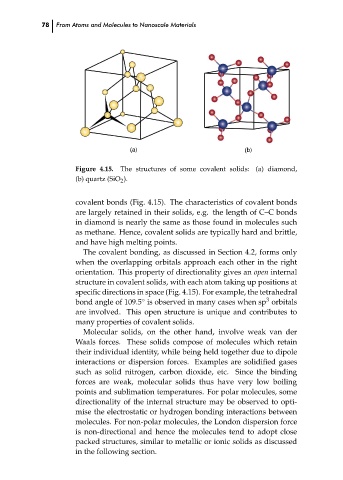
                                   Figure 4.15.
                                               The structures of some covalent solids: (a) diamond,
                                   (b) quartz (SiO 2 ).
                                   covalent bonds (Fig. 4.15). The characteristics of covalent bonds
                                   are largely retained in their solids, e.g. the length of C–C bonds
                                   in diamond is nearly the same as those found in molecules such
                                   as methane. Hence, covalent solids are typically hard and brittle,
                                   and have high melting points.
                                     The covalent bonding, as discussed in Section 4.2, forms only
                                   when the overlapping orbitals approach each other in the right
                                   orientation. This property of directionality gives an open internal
                                   structure in covalent solids, with each atom taking up positions at
                                   specific directions in space (Fig. 4.15). For example, the tetrahedral
                                                                                     3
                                                    ◦
                                   bond angle of 109.5 is observed in many cases when sp orbitals
                                   are involved. This open structure is unique and contributes to
                                   many properties of covalent solids.
                                     Molecular solids, on the other hand, involve weak van der
                                   Waals forces. These solids compose of molecules which retain    ch04
                                   their individual identity, while being held together due to dipole
                                   interactions or dispersion forces. Examples are solidified gases
                                   such as solid nitrogen, carbon dioxide, etc. Since the binding
                                   forces are weak, molecular solids thus have very low boiling
                                   points and sublimation temperatures. For polar molecules, some
                                   directionality of the internal structure may be observed to opti-
                                   mise the electrostatic or hydrogen bonding interactions between
                                   molecules. For non-polar molecules, the London dispersion force
                                   is non-directional and hence the molecules tend to adopt close
                                   packed structures, similar to metallic or ionic solids as discussed
                                   in the following section.

