


Page 90 - Science at the nanoscale
P. 90
7:6
                                                     RPS: PSP0007 - Science-at-Nanoscale
                   June 12, 2009
                              From Atoms and Molecules to Nanoscale Materials
                          80
                                                  (a)
                                                                          (b)
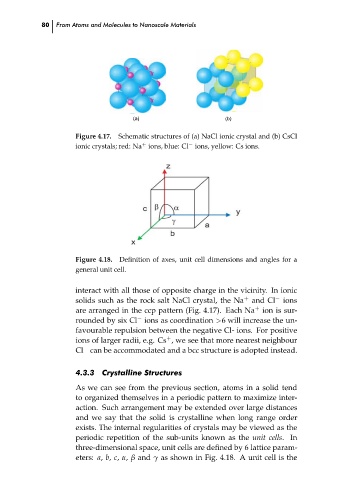
                                              Schematic structures of (a) NaCl ionic crystal and (b) CsCl
                                   Figure 4.17.
                                   ionic crystals; red: Na ions, blue: Cl ions, yellow: Cs ions.
                                                                −
                                                    +
                                   Figure 4.18.
                                              Definition of axes, unit cell dimensions and angles for a
                                   general unit cell.
                                   interact with all those of opposite charge in the vicinity. In ionic
                                                                                         ions
                                                                                       −
                                                                                 and Cl
                                   solids such as the rock salt NaCl crystal, the Na
                                                                               +
                                   are arranged in the ccp pattern (Fig. 4.17). Each Na ion is sur-
                                                                                  +
                                                   −
                                   rounded by six Cl ions as coordination >6 will increase the un-
                                   favourable repulsion between the negative Cl- ions. For positive
                                   ions of larger radii, e.g. Cs , we see that more nearest neighbour  ch04
                                                           +
                                   Cl can be accommodated and a bcc structure is adopted instead.
                                     −
                                   4.3.3  Crystalline Structures
                                   As we can see from the previous section, atoms in a solid tend
                                   to organized themselves in a periodic pattern to maximize inter-
                                   action. Such arrangement may be extended over large distances
                                   and we say that the solid is crystalline when long range order
                                   exists. The internal regularities of crystals may be viewed as the
                                   periodic repetition of the sub-units known as the unit cells. In
                                   three-dimensional space, unit cells are defined by 6 lattice param-
                                   eters: a, b, c, α, β and γ as shown in Fig. 4.18. A unit cell is the

