


Page 91 - Science at the nanoscale
P. 91
7:6
                                                     RPS: PSP0007 - Science-at-Nanoscale
                   June 12, 2009
                                                                   4.3. From Atoms to Solid Materials
                                                                 Axes and interaxial angles
                                        Bravais lattice cells
                                                                Three axes at right angles;
                                                                      all equal:
                                                                  a = b = c; α = β = γ =
                                                       Cubic F
                                            Cubic l
                                 Cubic P
                                                                Three axes at right angles;
                                                                      two equal:
                                                                  a = b =
                                                                       c; α = β = γ =
                                                                                90º
                               Tetragonal P
                                           Tetragonal l
                                                      Orthorhombic
                                                                Three axes at right angles;
                                                                       all unequal:
                                                                       c; α = β = γ =
                                                                     b =
                                                                  a =
                                                                                 90º
                                          C
                                  P
                                                          F
                                                   I
                                                                 Three axes, one pair not
                                                                at right angles, of any length:
                                                                              90º
                                                                        c; α = γ =      = β
                                                                     b =
                                                                  a =
                                                 Monoclinic C
                                    Monoclinic P
                                                                 Three axes, not at right
                                                                   angles, of any length:
                                                                   a =
                                                                     b =
                                                                           =
                                                                             =
                                                                                 90º
                                                                        c; α    β   γ  =
                                            Triclinic P
                                                                 Rhombohedral: three axes
                                                                    equally inclined,
                                                                 not at right angles; all equal:
                                                                  a = b = c; α = β = γ  90º
                                        Trigonal R (rhombohedral)
                                                                  Hexagonal: three equal
                                                                    axes coplanar at
                                                                  120 , fourth axis at right
                                                                    angles to these: = 90º   81    ch04
                                                                    a = a = a =  c
                                      Trigonal and hexagonal C(or P)  1  2  3
                                                                   α = β = 90º, γ = 120º
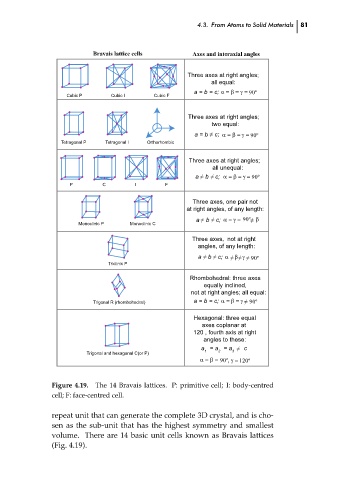
                             Figure 4.19.  The 14 Bravais lattices. P: primitive cell; I: body-centred
                             cell; F: face-centred cell.
                             repeat unit that can generate the complete 3D crystal, and is cho-
                             sen as the sub-unit that has the highest symmetry and smallest
                             volume. There are 14 basic unit cells known as Bravais lattices
                             (Fig. 4.19).

