


Page 84 - Science at the nanoscale
P. 84
7:6
                   June 12, 2009
                              From Atoms and Molecules to Nanoscale Materials
                          74
                                   6th power; while for many molecules, the repulsive force varies
                                   with the inverse 12th power of intermolecular distance. A good
                                   approximation to Fig. 4.10 is thus given by the Lennard-Jones
                                   potential:
                                                                A
                                                                     B
                                                         PE = −
                                                                  +
                                                                     12
                                                                 6
                                                                r
                                                                    r
                                   Here, A and B are both constants to be determined experimentally.
                                   The Lennard-Jones potential can also be expressed in various dif-
                                   ferent forms other than that given in Eq. 4.10.
                                   4.2.7
                                          Hydrogen Bonding
                                   Hydrogen bonding is a particular type of dipole-dipole
                                   interaction that is important and should be given special consid-
                                   eration. This occurs in molecules containing a hydrogen atom
                                   bonded to electronegative atoms such as O, N or F. The dipole
                                   generated through this bond will interact with another elec-
                                   tronegative atom (known as a hydrogen bond acceptor) forming the
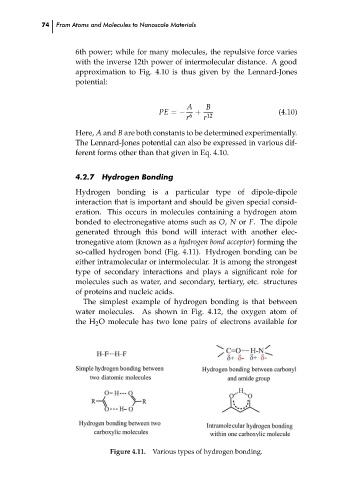
                                   so-called hydrogen bond (Fig. 4.11). Hydrogen bonding can be
                                   either intramolecular or intermolecular. It is among the strongest
                                   type of secondary interactions and plays a significant role for
                                   molecules such as water, and secondary, tertiary, etc. structures
                                   of proteins and nucleic acids.
                                     The simplest example of hydrogen bonding is that between
                                   water molecules. As shown in Fig. 4.12, the oxygen atom of
                                   the H 2 O molecule has two lone pairs of electrons available for
                                            Figure 4.11. RPS: PSP0007 - Science-at-Nanoscale  (4.10)  ch04
                                                       Various types of hydrogen bonding.

