


Page 220 - Separation process principles 2
P. 220
Exercises  185


        8,  single-section  membrane  cascades  increase  purity  of  one   the  number  of unique  variables  and  the  number  of  independent
             and recovery of the main component in that product.   equations that relate  the variables.  For a single-section,  counter-
                                                           current cascade, the recovery of one component can be specified.
        9.  Hybrid systems of different types reduce energy expenditures,
        make  possible  separations  that  are  otherwise  difficult,  andlor   For  a  two-section  countercurrent  cascade,  the  recoveries  of  two
        improve the degree of separation.                  components can be specified.
        10.  The number of degrees of freedom (number of specifications)
       for a mathematical model of a cascade is the difference between

       REFERENCES
  f
        1.  BERDT, R.J., and C.C. LYNCH, Am. Chem. Soc., 66,282-284  (1944).   6.  PRASAD, R., E NOTARO, and D.R. THOMPSON, J. Membrane Science, 94,
                              J.
  I                                                        Issue 1,225-248  (1994).
       2.  KREMSER, A., Natl.  Petroleum News, 22(21), 4349 (May 21,  1930).
                                                           7.  BERRY, D.A., and K.M. NG,AIC~E J., 43,1751-1762  (1997).
       3.  EDMISTER, W.C., AIChE J., 3,165-171  (1957).
       4.  SMITH, B.D., and W.K. BRINKLEY, AIChE J., 6,446450 (1960).   8.  KWAUK, M., AIChE J., 2,240-248  (1956).
  P
                                           and
       5.  LYSTER, W.N., S.L. SULLIVAN, D.S. BILLINGSLEY, C.D. HOLLAND,   9.  GILLILAND, E.R., and C.E. REED, Ind. Eng. Chem., 34,55 1-557  (1942).
                             Jr.,
       petroleum Refinel; 38(6), 221-230  (1959).
       EXERCISES
  /    Section 51                                          where 100 mg each of solutes A and B are dissolved in 100 ml of
                                                           water. After  adding  100 ml  of  an  organic  solvent  that  is  more
  t    5.1  Devise  an  interlinked  cascade  of  the  type  shown  in  Fig-
       ure 5.2e, but consisting  of  three columns  for the separation of a   selective for A than B, the distribution  of A and B becomes  that
  L                                                       shown for equilibration 1 with vessel  1. The organic-rich phase is
       four-component feed into four products.
                                                          transferred  to vessel 2 (transfer), leaving the water-rich  phase in
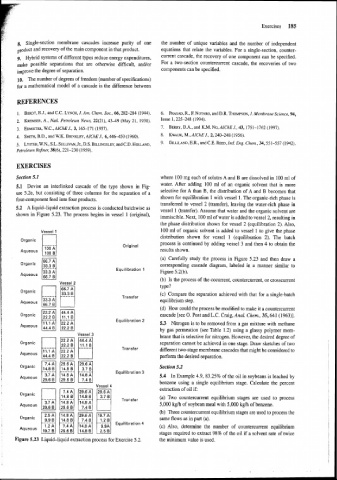
       5.2  A liquid-liquid  extraction process is conducted batchwise as   vessel  1 (transfer). Assume that water and the organic solvent are
       shown in Figure  5.23. The process begins  in vessel  1 (original),
                                                          immiscible. Next, 100 ml of water is added to vessel 2, resulting in
                                                          the phase distribution  shown for vessel 2 (equilibration  2). Also,
                                                           100 ml of organic solvent is added to vessel  1 to give the phase
                Vessel 1
         Organic  1   I                                   distribution  shown  for  vessel  1  (equilibration  2).  The  batch
         Aqueous  [Ei]                       Original     process is continued by adding vessel 3 and then 4 to obtain the
                                                          results shown.
                                                          (a)  Carefully  study the process  in Figure 5.23 and  then  draw  a
                 66.7 A
         Organic                                          corresponding  cascade  diagram,  labeled  in  a  manner  similar  to
                                           Equilibration 1
                 33.3 A                                   Figure 5.2(b).
         Aqueous   66.7 B
                                                          (b)  Is the process of the cocurrent, countercurrent, or crosscurrent
                       Vessel 2
                                                          type?
                       66.7 A
         Organic
                       33.3 B                             (c)  Compare the separation achieved with that for a single-batch
                                             Transfer
         Aqueous                                          equilibrium step.
                                                          (d)  How could the process be modified to make it a countercurrent
                                                          cascade [see 0. Post and L.C. Craig, Anal. Chem., 35,641 (1963)l.
                                           Equilibration 2
                                                          5.3  Nitrogen is to be removed from a gas mixture with methane
                                                          by  gas permeation  (see Table 1.2) using a glassy polymer  mem-
                             Vessel 3
                                                          brane that is selective for nitrogen. However, the desired degree of
         Organic                                          separation cannot be achieved in one stage. Draw sketches of two
                                             Transfer     different two-stage membrane cascades that might be considered to
         Aqueous                                          perform the desired separation.
                              29.6 A
                 7.4 A   29.6 A   fj                                                                                  !
         Organic                                          Section 5.2
                                           Equilibration 3                                                            I
                 3.7A   14.8A   14.8A                     5.4  In Example 4.9, 83.25% of the oil in soybeans is leached by   I
         Aqueous   29.6 B   29.6 B
                                                          benzene  using  a  single  equilibrium  stage.  Calculate  the  percent   I
                                    . - - - - .
                                    Vessel 4  .
                                                          extraction of oil if:                                       1
                                    29.6 A
         Organic
                                             Transfer     (a)  Two  countercurrent  equilibrium  stages  are  used  to  process
         Aqueous                                          5,000 kg/h of soybean meal with 5,000 kgh of benzene.
                                                          (b)  Three countercurrent equilibrium stages are used to process the
                                                          same flows as in part (a).
                                                          (c)  Also,  determine  the  number  of  countercurrent  equilibrium
                                                          stages required to extract 98% of the oil if a solvent rate of twice
                                                                                                                      I
       Figure 5.23  Liquid-liquid  extraction process for Exercise 5.2.   the minimum value is used.
                                                                                                                      I

