


Page 222 - Separation process principles 2
P. 222
Exercises  187


      5-17  Solve Example 5.3 with the addition of a heat exchanger at
                                                                                        D = 230 kmollh
      each stage so as to maintain isothermal operation of the absorber at
      (a)  125°F
      (b) 150°F
                                                                      kmollh
      What is the effect of temperature on absorption in the range of  100
      to 150°F?
      5.18  One million pound-moles per day of a gas of the following
               is to be absorbed by n-heptane at -30°F  and 550 psia
      in an absorber having  10 theoretical stages so as to absorb 50% of   Figure 5.24  Conditions for Exercise 5.23.
      the ethane. Calculate the required  flow rate of  absorbent  and the
      distribution, in lbmoh, of all the components between the exiting
      gas and liquid streams.                                                by =$       D = 45krnollh

                                      K-value @
                                                                    Feed,
                         Mole Percent   -30°F  and             Bubble-point liquid
            Component    in Feed Gas   550 psia
                                                                       kmollh


                                                         Figure 5.25  Conditions for Exercise 5.24.

      5.19  A stripper operating at 50 psia with three equilibrium stages
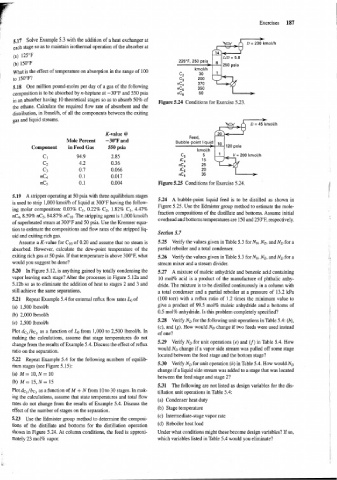
                                                         5.24  A bubble-point  liquid  feed  is  to be  distilled  as  shown in
      is used to strip 1,000 kmoh of liquid at 300°F having the follow-
                                                         Figure 5.25. Use the Edmister group method to estimate the mole-
      ing  molar composition:  0.03%  CI, 0.22%  C2, 1.82% C3, 4.47%
                                                         fraction compositions of the distillate and bottoms. Assume initial
      nC4, 8.59% nC5, 84.87% nClo. The stripping agent is 1,000 kmollh
                                                         overhead and bottoms temperatures are 150 and 250°F, respectively.
      of superheated steam at 300°F and 50 psia. Use the Kremser equa-
      tion to estimate the compositions and flow rates of the stripped liq-
                                                         Section 5.7
      uid and exiting rich gas.
        Assume a K-value for Clo of 0.20 and assume that no steam is   5.25  Verify the values given in Table 5.3 for NV, NE, and ND for a
      absorbed.  However,  calculate  the  dew-point  temperature  of  the   partial reboiler and a total condenser.
      exiting rich gas at 50 psia. If that temperature is above 300°F, what   5.26  Verify the values given in Table 5.3 for Nv, NE, and ND for a
      would you suggest be done?                         stream mixer and a stream divider.
      5.20  In Figure 5.12, is anything gained by totally condensing the   5.27  A mixture of maleic anhydride and benzoic acid containing
      vapor leaving each stage? Alter the processes in Figure 5.12a and   10 mol% acid is a product  of  the manufacture  of  phthalic  anhy-
      5.12b so as to eliminate the addition of heat to stages 2 and 3 and   dride. The mixture is to be distilled continuously in a column with
      still achieve the same separations.                a total condenser  and a partial reboiler at a pressure of  13.2 kPa
      5.21  Repeat Example 5.4 for external reflux flow rates Lo of   (100 ton) with a reflux ratio of  1.2 times the minimum value to
      (a)  1,500 1bmoVh                                  give a product of  99.5 mol% maleic anhydride and a bottoms of
                                                         0.5 mol% anhydride. Is this problem completely specified?
      (b)  2,000 lbmollh
                                                         5.28  Verify ND for the following unit operations in Table 5.4: (b),
      (c)  2,500 lbmollh
                                                         (c), and (g). How would ND change if two feeds were used instead
      Plot dc3/bc3 as a function of Lo from  1,000 to 2,500 lbmollh. In
                                                         of one?
      making  the  calculations,  assume  that  stage temperatures  do not
                                                         5.29  Verify ND for unit operations (e) and (f) in Table 5.4. How
      change from the results of Example 5.4. Discuss the effect of reflux
                                                         would ND change if a vapor side stream was pulled off some stage
      ratio on the separation.
                                                         located between the feed stage and the bottom stage?
      5.22  Repeat Example 5.4 for the following numbers of equilib-
                                                         5.30  Verify ND for unit operation (h) in Table 5.4. How would ND
      rium stages (see Figure 5.15):
                                                         change if a liquid side stream was added to a stage that was located
      (a)  M=  10,N= 10
                                                         between the feed stage and stage 2?
      (b)  M = 15, N = 15
                                                         5.31  The following are not listed as design variables for the dis-
      Plot dc,/bc3  as a function of M + N  from 10 to 30 stages. In mak-
                                                         tillation unit operations in Table 5.4:
      ing the calculations,  assume that state temperatures and total flow
                                                         (a)  Condenser heat duty
      rates do not change from the results of Example 5.4. Discuss the
                                                         (b)  Stage temperature
      effect of the number of stages on the separation.
                                                         (c)  Intermediate-stage vapor rate
      5.23  Use the Edmister group method to determine the composi-
                                                         (d)  Reboiler heat load
      tions  of  the  distillate  and  bottoms  for  the  distillation  operation
      shown in Figure 5.24. At column conditions, the feed is approxi-   Under what conditions might these become design variables? If so,
      mately 23 mol% vapor.                              which variables listed in Table 5.4 would you eliminate?

