


Page 219 - Separation process principles 2
P. 219
184  Chapter 5  Cascades and Hybrid Systems

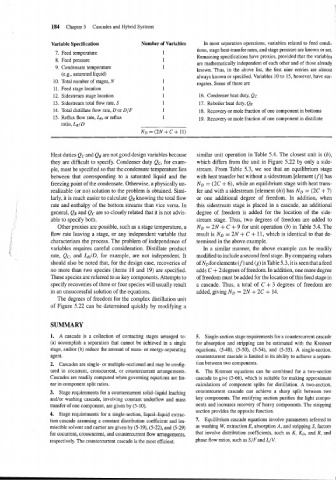
                   Variable Specification          Number of Variables   In  most separation operations, variables related to feed condi-
                                                                       tions, stage heat-transfer rates, and stage pressure are known or set.
                     7.  Feed temperature                  1
                                                                       Remaining specifications have proxies, provided that the variables
                     8. Feed pressure                      1
                                                                       are mathematically independent of each other and of  those already
                     9.  Condensate temperature            1
                                                                       known. Thus, in  the above list, the first nine entries are almost
                       (e.g., saturated liquid)
                                                                       always known or specified. Variables 10 to 15, however, have sur-
                    10. Total number of stages, N
                                                                       rogates. Some of these are
                    11. Feed stage location
                    12. Sidestream stage location                       16. Condenser heat duty, Qc
                    13. Sidestream total flow rate, S                  17. Reboiler heat duty, QR
                    14. Total distillate flow rate, D or DIF           18. Recovery or mole fraction of one component in bottoms
                    15. Reflux flow rate, LR, or reflux                19. Recovery or mole fraction of one component in distillate
                       ratio, LR/D


                   Heat duties Qc and QR are not good design variables because   similar unit operation in Table 5.4. The closest unit  is  (b),
                   they are difficult to specify. Condenser duty Qc, for exam-   which differs from the unit  in Figure 5.22 by  only a side-
                   ple, must be speciiied so that the condensate temperature lies   stream. From Table 5.3,  we  see that  an equilibrium stage
                   between  that  corresponding  to a  saturated  liquid  and  the   with heat transfer but without a sidestream [element (f)] has
                   freezing point of the condensate. Otherwise, a physically un-   ND = (2C + 6), while an equilibrium stage with heat trans-
                   realizable (or no) solution to the problem is obtained. Simi-   fer and with a sidestream [element (h)] has ND = (2C + 7)
                   larly, it is much easier to calculate QR knowing the total flow   or  one  additional  degree  of  freedom.  In  addition,  when
                   rate and enthalpy of the bottom streams than vice versa. In   this  sidestream stage is placed in a  cascade, an  additional
                   general, QR and Qc are so closely related that it is not advis-   degree  of  freedom  is  added  for the  location  of  the  side-
                   able to specify both.                               stream  stage. Thus, two degrees of  freedom  are added to
                      Other proxies are possible, such as a stage temperature, a   ND = 2N + C + 9 for unit operation (b) in Table 5.4. The
     I             flow rate leaving a  stage, or any independent  variable that   result is ND = 2N + C + 11, which is identical to that de-
                   characterizes the process. The problem of independence of   termined in the above example.
     I
                   variables  requires careful consideration.  Distillate  product   In  a similar manner,  the  above example can be readily
     11
     I             rate,  Qc,  and  LRID, for  example,  are  not  independent.  It   modified to include a second feed stage. By comparing values
                   should also be noted that, for the design case, recoveries of   of ND for elements (f) and (g) in Table 5.3, it is seen that a feed
                   no more than two species (items  18 and  19) are specified.   adds C + 2 degrees of freedom. In addition, one more degree
                   These species are referred to as key components. Attempts to   of freedom must be added for the location of this feed stage in
                   specify recoveries of three or four species will usually result   a  cascade. Thus,  a  total  of  C + 3 degrees  of  freedom are
                   in an unsuccessful solution of the equations.       added, giving ND = 2N + 2C + 14.
                      The degrees of freedom for the complex distillation unit
                   of  Figure 5.22 can be determined quickly by  modifying a


                   SUMMARY

                   1.  A  cascade is  a collection of  contacting stages  arranged to:   5.  Single-section stage requirements for a countercurrent cascade
                   (a) accomplish a separation that cannot be  achieved in  a single   for absorption and  stripping can be estimated with  the  Kremser
                   stage, andor (b) reduce the amount of mass- or energy-separating   equations,  (5-48), (5-50), (5-54),  and  (5-55). A  single-section,
                   agent.                                              countercurrent cascade is limited in its ability to achieve a separa-
                   2.  Cascades are single- or multiple-sectioned and may be config-   tion between two components.
                   ured  in  cocurrent, crosscurrent, or  countercurrent arrangements.   6.  The Kremser  equations can  be  combined  for  a two-section
                   Cascades are readily computed when governing equations are lin-   cascade to give (5-66), which is suitable for making approximate
                   ear in component split ratios.                     calculations of  component  splits for  distillation. A  two-section,
                   3.  Stage requirements for a countercurrent solid-liquid  leaching   countercurrent cascade  can  achieve  a  sharp  split  between  two
                   andor washing cascade, involving constant underflow  and  mass   key components. The rectifying section purifies the light compo-
                   transfer of one component, are given by  (5-10).   nents and increases recovery of  heavy components. The stripping
                                                                      section provides the opposite function.
                   4.  Stage requirements for a single-section, liquid-liquid  extrac-
                   tion cascade assuming a constant distribution coefficient and im-   7.  Equilibrium cascade equations involve parameters referred to
                   miscible solvent and carrier are given by  (5-19), (5-22), and (5-29)   as washing W,  extraction E, absorption A, and stripping S, factors
                   for cocurrent, crosscurrent, and countercurrent flow arrangements,   that involve distribution coefficients, such as K, KD, and R,  and
                   respectively. The countercurrent cascade is the most efficient.   phase flow ratios, such as SIF and LIV.

