


Page 214 - Separation process principles 2
P. 214
5.7  Degrees of Freedom and Specifications for Countercurrent Cascades  179


         Specification of these (2C + 6) variables permits calcu-   adiabatic  or  nonadiabatic  equilibrium-stage  element,  the
       lation  of  the  unknown  variables  LOUT, VOUT, (x~)~,~, total number of variables from (5-68) is
       (ye) vrN, all (x, )LOUT, TOUT, and all (yi) v0,,  , where C denotes
       the missing mole fractions in the two entering streams.   (Nvlunit = N(4C + 13) - [2(N - l)](C + 3) + 1
                                                                    =7N+2NC+2C+7
       single-Section, Countercurrent Cascade             since  2(N - 1)  interconnecting  streams  exist.  The  addi-
                                                          tional variable is the total number of  stages (i.e., NA = 1).
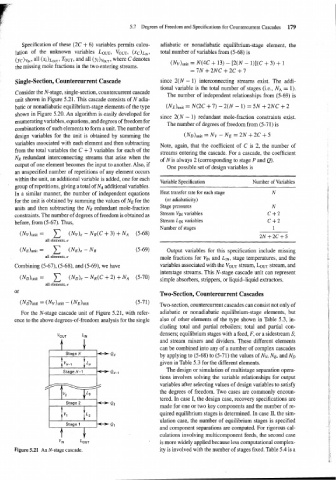
       Consider the N-stage, single-section, countercurrent cascade
                                                            The number of independent relationships from (5-69) is
       unit shown in Figure 5.21. This cascade consists of N adia-
       batic or nonadiabatic equilibrium-stage elements of the type   (N~)unlt = N(2C + 7) - 2(N - 1) = 5N + 2NC + 2
       shown in Figure 5'20 An      Is              for   since 2(N - 1) redundant mole-fraction constraints exist,
       enumerating variables, equations, and degrees of freedom for
                                                            The number of degrees of freedom from (5-7  is
       combinations of such elements to form a unit. The number of
       design  variables for the  unit is obtained by  summing the
       variables associated with each element and then subtracting   Note,  again, that the coefficient of  C is 2,  the number of
       from the total variables the C + 3 variables for each of the
                                                          streams entering the cascade. For a cascade, the coefficient
       NR redundant interconnecting streams that arise when  the
                                                          of N is always 2 (corresponding to stage P and Q).
       output of one element becomes the input to another. Also, if   One possible set of design variables is
       an unspecified number of repetitions of any element occurs
       within the unit, an additional variable is added, one for each
                                                          Variable Specification          Number of Variables
       group of repetitions, giving a total of NA additional variables.
       In a similar manner, the  number of  independent equations   Heat transfer rate for each stage   N
       for the unit is obtained by summing the values of NE for the   (or adiabaticity)
      units and  then subtracting the NR redundant mole-fraction   Stage pressures               N
      constraints. The number of degrees of freedom is obtained as   Stream VN  variables       C+2
      before, from (5-67). Thus,                          Stream LN variables                   C+2
                                                          Number of  stages                       1
                                                                                             2N+2C+5
                 all elements, e
        (N~Iunit =  1 (NEL - NR                  (5-69)     Output  variables for this  specification include missing
                 all elements, e                          mole fractions for Vm and LIN, stage temperatures, and the
      Combining (5-67), (5-68), and (5-69), we have       variables associated with the VoUT stream, LOUT stream, and
                                                          interstage streams. This N-stage cascade unit can represent
        (N~)unit =  C  (ND)~ - NR(C + 2) + NA  (5-70)     simple absorbers, strippers, or liquid-liquid  extractors.
                 all elements, e
      or
                                                          Two-Section, Countercurrent Cascades
                                                          Two-section, countercurrent cascades can consist not only of
         For the N-stage cascade unit of  Figure 5.21, with refer-   adiabatic or  nonadiabatic equilibrium-stage elements, but
      ence to the above degrees-of-freedom analysis for the single   also of  other elements of the type  shown in Table 5.3, in-
                                                          cluding  total  and  partial  reboilers;  total  and  partial  con-
                                                          densers; equilibriuh stages with a feed, F, or a sidestream S;
                                                          and  stream mixers and dividers. These  different elements
                                                          can be combined into any of a number of complex cascades
                   Ei-                                    by applying to (5-68) to (5-71) the values of Nv, NE, and ND
                         Stage N
                                                          given in Table 5.3 for the different elements.
                 w                                        tions involves solving the variable relationships for output
                                                            The design or simulation of multistage separation opera-
                        Stage N-I
                                        QN-i
                                        Q~
                                                          variables after selecting values of design variables to satisfy
                                                          the degrees of freedom. Two cases are commonly encoun-
                                                          tered. In case I, the design case, recovery specifications are
                         Stage 2
                                                          made for one or two key components and the number of re-
                                                          quired equilibrium stages is determined. In case 11, the sim-
                                                          ulation case, the number of  equilibrium stages is specified
                                        Q2
                         Stage 1
                   ITWQ1                                  and component separations are computed. For rigorous cal-
                                                          culations involving multicomponent feeds, the second case
                      VI N    L~~~                        is more widely applied because less computational complex-
      Figure 5.21  An N-stage cascade.                    ity is involved with the number of stages fixed. Table 5.4 is a

