


Page 212 - Separation process principles 2
P. 212
5.7  Degrees of Freedom and Specifications for Countercurrent Cascades  177


                                Minimum-boiling           overcome the limitations of  eutectics in crystallization and
                                   azeotrope, Az          azeotropes  in  distillation.  Furthermore,  although  streams
                              r-----                      containing solids are more difficult to process than  fluids,
                - 1    A   Distillation  I                crystallization requires just  a  single stage to  obtain high-


                         1         I                      purity crystals. Figure 5.19 includes one of the many distil-
                 B
                                   Nearly pure A
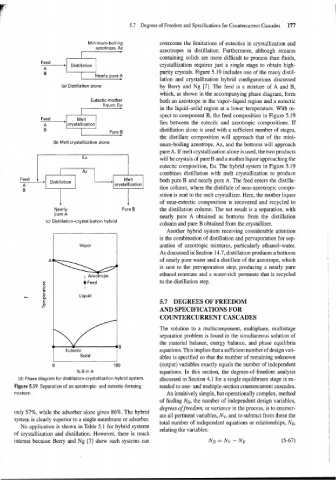
                                                          lation  and  crystallization hybrid  configurations discussed
                       (a) Distillation alone             by  Berry  and Ng  [7]. The  feed is a mixture  of  A and B,
                                                          which, as shown in the accompanying phase diagram, form
                                 Eutectic mother          both an azeotrope in the vapor-liquid  region and a eutectic
                                      liquor, Eu
                                                          in the liquid-solid  region at a lower temperature. With re-
                                                          spect to component B, the feed composition in Figure 5.19
                                                          lies  between  the  eutectic and  azeotropic compositions. If
                 A
                 B                                        distillation alone is used with a sufficient number of stages,
                                        Pure B
                                                          the  distillate composition will  approach that  of  the  mini-
                    (b) Melt crystallization alone
                                                          mum-boiling azeotrope, Az, and the bottoms will approach
                                                          pure A. If melt crystallization alone is used, the two products
                                                          will be crystals of pure B and a mother liquor approaching the
                                                          eutectic composition, Eu. The hybrid system in Figure 5.19
                   Distillation  1        crys~~~atioo    combines distillation with  melt  crystallization to  produce
                                                    1
                                                          both pure B and nearly pure A. The feed enters the distilla-
                                                          tion column, where the distillate of near-azeotropic compo-
                                                          sition is sent to the melt crystallizer. Here, the mother liquor
                      1                       1           of  near-eutectic composition is recovered and recycled to
                     Nearly                 Pure B        the distillation column. The net result is a separation, with
                    pure A
                                                          nearly  pure  A  obtained  as  bottoms  from  the  distillation
                  (c) Distillation-crystallization  hybrid
                                                          column and pure B obtained from the crystallizer.
                                                            Another hybrid system receiving considerable attention
                                                          is the combination of distillation and pervaporation for sep-
                             Vapor                        aration of  azeotropic mixtures, particularly ethanol-water.
                                                          As discussed in Section 14.7, distillation produces a bottoms
                                                          of nearly pure water and a distillate of the azeotrope, which
                                                          is sent to  the pervaporation step, producing a nearly  pure
                                                          ethanol retentate and a water-rich permeate that is recycled
                               ,  Azeotrope
                               + Feed                     to the distillation step.
                               I
                             Liquid
                                                          5.7  DEGREES OF FREEDOM
                                                          AND SPECIFICATIONS FOR
                                                          COUNTERCURRENTCASCADES
                                                          The  solution  to  a  multicomponent, multiphase,  multistage
                                                          separation problem is found in the simultaneous solution of
                                                          the material balance, energy balance, and phase equilibria
                                                          equations. This implies that a sufficient number of design vari-
                    I         Solid        I              ables is specified so that the number of remaining unknown
                    0                    100              (output) variables exactly equals the number of independent
                            %BinA                         equations. In  this section, the degrees-of-freedom analysis
        (d) Phase diagram for distillation-crystallization  hybrid system.   discussed in Section 4.1 for a single equilibrium stage is ex-
      Figure 5.19  Separation of an azeotropic- and eutectic-forming   tended to one- and multiple-section countercurrent cascades.
      mixture.                                              An intuitively simple, but operationally complex, method
                                                          of finding ND, the number of independent design variables,
                                                          degrees offreedom, or variance in the process, is to enumer-
                    the             gives 86% The         ate all              Nv, and to subtract from these the
          57%7
      system is clearly superior to a single membrane or adsorber.   total number of independent equations or relationships, NE,
         No application is shown in Table 5.1 for hybrid systems
                                                          relating the variables:
      of  crystallization and distillation. However, there is much
      interest because Berry and Ng  [7] show such systems can             No  = Nv - NE             (5-67)

