


Page 207 - Separation process principles 2
P. 207
172  Chapter 5  Cascades and Hybrid Systems


                 mole  fraction  is reduced  from 0.866 to 0.815, but  hexane                            Total
                                                                             Total                     condenser
                 recovery is increased to 36.1(0.815)/50 or 58.8%.         condenser   163.5"~. D = 36.1    Distillate
                                                                                                   =
                                                                           Q = 874 MBH          XH~ 0.872
                   Both of the successive flash arrangements in Figure 5.12                                 Reflux, L,
                 involve  a  considerable  number  of  heat  exchangers  and
                 pumps.  Except  for  stage  1,  the  heaters  in  Figure  5.12a
                 can  be  eliminated  if  the  two  intermediate  total  con-
                 densers  are  converted  to  partial  condensers  with  duties
                                                                                    Stage 2
                 of  734 - 487 = 247 MBH  (MBH = 1,000 Btulh)  and                                             section
                 483 - 376 = 107 MBH.  Total  heating  duty  is  now  oilly
                 751,000  Btuk,  and  total  cooling  duty  is  731,000  Btulh.
                                                                                    Stage 1              Stage
                 Similarly, if heaters for stages 2 and 3 in Figure 5.12b are       215OF          Feed ;a
                 removed  by  converting  the two total  condensers to partial   F= 100  Q = 904 MBH   -
                                                                       Feed  AT\ 63.9
                                                                     T,  = 192.3'F      xH:  i0.290
                 condensers, total heating duty is 904,000 Btuk (20% greater   XHZ = 0.50
                 than the no-recycle case), and cooling duty is 864,000 Btuk   Boiler   (a)
                 (18% greater than the no-recycle case).
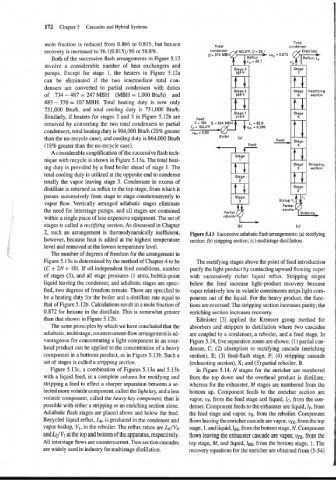
                   A considerable simplification of the successive flash tech-
                                                                                    Stage
                 nique with recycle is shown in Figure 5.13a. The total heat-
                 ing duty is provided by a feed boiler ahead of  stage 1. The                                  section
                 total cooling duty is utilized at the opposite end to condense
                                                                                    Stage
                 totally  the vapor leaving stage 3. Condensate in excess of                            H
                 distillate is returned as reflux to the top stage, from which it                        Stage
                 passes successively from stage to stage countercurrently to        Stage
                                                                                                    Boilup V,
                 vapor  flow. Vertically  arranged  adiabatic  stages  eliminate
                 the need for interstage pumps, and all stages are contained    Partial              rebo~ler   Bottoms
                 within a single piece of less expensive equipment. The set of   reboiler
                                                                                                     parti7  +
                 stages is called a rectifiing section. As discussed in Chapter
                 2,  such  an  arrangement  is  thermodynanlically  inefficient,   Figure 5.13  Successive adiabatic flash arrangements: (a) rectifying
                 however, because  heat is added at the highest temperature   section; (b) stripping section; (c) multistage distillation.
                 level and removed at the lowest temperature level.
                   The number of degrees of freedom for the arrangement in
                 Figure 5.13a is determined by the method of Chapter 4 to be   The rectifying stages above the point of feed introduction
                 (C + 2N + 10). If  all independent feed conditions, number   purify the light product by contacting upward flowing vapor
                 of  stages (3), and all stage pressures (1 atm), bubble-point   with  successively  richer  liquid  reflux.  Stripping  stages
                 liquid leaving the condenser, and adiabatic stages are speci-   below  the  feed  increase  light-product  recovery  because
                 fied, two degrees of freedom remain. These are specified to   vapor relatively low in volatile constituents strips light com-
                 be a heating duty for the boiler and a distillate rate equal to   ponents out of  the liquid. For the heavy product, the func-
                 that of Figure 5.12b. Calculations result in a mole fraction of   tions are reversed: The stripping section increases purity; the
                 0.872 for hexane in the distillate. This is somewhat greater   enriching section increases recovery.
                 than that shown in Figure 5.12b.                      Edmister  [3]  applied  the  Kremser  group  method  for
                   The same principles by which we have concluded that the   absorbers and  strippers to  distillation where  two  cascades
                 adiabatic, multistage, countercurrent-flow arrangement is ad-   are coupled to a condenser, a reboiler, and a feed stage. In
                 vantageous for concentrating a light component in an over-   Figure 5.14, five separation zones are shown: (1) partial con-
                 head product can be applied to the concentration of a heavy   denser,  C; (2)  absorption  or rectifying  cascade  (enriching
                 component in a bottoms product, as in Figure 5.13b. Such a   section), E;  (3)  feed-flash  stage, F;  (4)  stripping  cascade
                 set of stages is called a stripping section.       (exhausting section), X; and (5) partial reboiler, B.
                   Figure 5.13c, a combination of  Figures 5.13a and 5.13b   In Figure  5.14, N stages for the  enricher are numbered
                 with a liquid  feed, is a complete column for rectifying  and   from the  top  down  and  the  overhead  product  is distillate;
                 stripping a feed to effect a sharper separation between a se-   whereas for the exhauster, M stages are numbered from the
                 lected more volatile component, called the light key, and a less   bottom  up.  Component  feeds  to  the  enricher  section  are
                 volatile component, called the heavy key component, than is   vapor, vfi from the feed stage and liquid, lc, from the con-
                 possible with either a stripping or an enriching section alone.   denser. Component feeds to the exhauster are liquid, LA  from
                 Adiabatic flash stages are placed above and below the feed.   the feed stage and vapor, v~, from the reboiler.  Component
                 Recycled liquid reflux, LR, is produced in the condenser and   flows leaving the enricher cascade are vapor, UTE, from the top
                 vapor boilup, V1, in the reboiler. The reflux ratios are LR/VN   stage, 1, and liquid, lBE, from the bottom stage, N. Component
                 and L2/V1 at the top and bottom of the apparatus, respectively.   flows leaving the exhauster cascade are vapor, vm, from the
                 All interstage flows are countercurrent. Two-section cascades   top stage, M, and liquid, lBx, from the bottom stage, 1. The
                 are widely used in industry for multistage distillation.   recovery equations for the enricher are obtained from (5-54)

