


Page 206 - Separation process principles 2
P. 206
5.4  Multicomponent Vapor-Liquid  Cascades  171


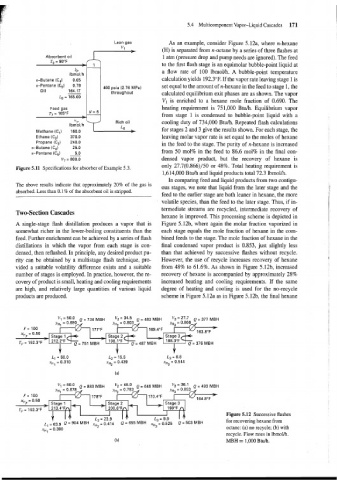
                                                             As an example, consider Figure 5.12a, where n-hexane
                                                           (H) is separated from n-octane by a series of three flashes at
                 Absorbent oil                             1 atm (pressure drop and pump needs are ignored). The feed
                   To = 90°F
                              >                           to the first flash stage is an equimolar bubble-point liquid at
                            '0,                           a  flow  rate  of  100 lbmolk. A  bubble-point  temperature
                          Ibmol/h
              n-Butane  (C4)   0.05                       calculation yields 192.3"F. If the vapor rate leaving stage 1 is
              n-Pentane  (C5)   0.78   400 psia (2.76 MPa)   set equal to the amount of n-hexane in the feed to stage 1, the
                         164.17
                Oil      -               throughout       calculated equilibrium exit phases are as shown. The vapor
                      Lo = 165.00
                                                           V1  is  enriched  to  a  hexane  mole  fraction  of  0.690.  The
                   Feed gas                               heating requirement is  751,000 Btuh. Equilibrium vapor
                   T,  = 105OF
                                                          from  stage  1 is  condensed to  bubble-point  liquid  with  a
                                          Rich oil        cooling duty of 734,000 Btuh. Repeated flash calculations
                          Ibmollh
              Methane (C1)   160.0                        for stages 2 and 3 give the results shown. For each stage, the
              Ethane (C2)   370.0                         leaving molar vapor rate is set equal to the moles of hexane
              Propane (C3)   240.0                        in the feed to the stage. The purity of n-hexane is increased
            n-Butane  (C4)   25.0
            n-Pentane  (C5)   -                           from 50 mol% in the feed to 86.6 mol% in the final con-
                            5.0
                       v, = 800.0                         densed  vapor  product,  but  the  recovery  of  hexane  is
                                                          only 27.7(0.866)/50  or 48%. Total heating requirement is
       Figure 5.11  Specifications for absorber of Example 5.3.
                                                           1,614,000  Btu/h and liquid products total 72.3 lbmolk.
                                                             In comparing feed and liquid products from two contigu-
       The above results indicate that  approximately 20% of  the gas is   ous stages, we note that liquid from the later stage and the
       absorbed. Less than 0.1  % of the absorbent oil is stripped.
                                                          feed to the earlier stage are both leaner in hexane, the more
                                                          volatile species, than the feed to the later stage. Thus, if  in-
                                                          termediate streams are recycled, intermediate recovery of
       Two-Section Cascades
                                                          hexane is improved. This processing scheme is depicted in
       A  single-stage flash  distillation produces  a  vapor  that  is   Figure 5.12b, where again the molar fraction vaporized in
       somewhat richer in the lower-boiling constituents than the   each stage equals the mole fraction of hexane in the com-
       feed. Further enrichment can be achieved by a series of flash   bined feeds to the stage. The mole fraction of hexane in the
       distillations in  which  the  vapor  from  each  stage  is  con-   final  condensed vapor product is  0.853, just  slightly less
       densed, then reflashed. In principle, any desired product pu-   than  that  achieved by  successive flashes  without recycle.
       rity  can be  obtained by  a multistage flash technique, pro-   However, the use of  recycle increases recovery of  hexane
       vided  a  suitable volatility difference exists and  a  suitable   from 48% to 61.6%. As shown in Figure 5.12b, increased
       number of stages is employed. In practice, however, the re-   recovery of hexane is accompanied by approximately 28%
       covery of product is small, heating and cooling requirements   increased  heating  and  cooling  requirements.  If  the  same
       are high,  and  relatively large quantities of  various  liquid   degree  of  heating  and  cooling  is  used  for  the  no-recycle
       products are produced.                             scheme in Figure 5.12a as in Figure 5.12b, the final hexane


                                                      6 MBH   V3  = 36.1   Q = 493 MBH
                                                             j'~~ 0.853&
                                                                =
                                                                            >
                                                      170.4"F
                                                                       164.8"F
                 L,  = 63.9  Q = 904 MBH .                                       Figure 5.12  Successive flashes
                                                                                 for recovering hexane from
                                                                                 octane: (a) no recycle; (b) with
                                                                                 recycle. Flow rates in lbmollh.
                                                                                 MBH = 1,000 Btu/h.

