


Page 201 - Separation process principles 2
P. 201
166  Chapter 5  Cascades and Hybrid Systems


                   Combining the equations in (5-20) to eliminate all interme-   the countercurrent arrangement is greater than for the cross-
                   diate interstage variables, x:),   the final raffinate mass ratio   current arrangement, and the difference increases exponen-
                   is given by                                        tially  with  increasing  extraction  factor,  E.  Therefore,  the
                                                                      countercurrent  cascade  is  the  most  efficient  of  the  three
                                                                      linear cascades.
                                                                         For an infinite number of equilibrium stages, the limit of
                   Interstage values of x:)   are obtained similarly from   (5-28) gives two results:


                   Thus, unlike the cocurrent cascade, the value of XB decreases   Thus,  complete  extraction  can  be  achieved in a  counter-
                   in each successive stage. For an infinite number of equilib-   current cascade, but only for an extraction factor, E, greater
                   rium stages, (5-21) becomes                        than  1.

                                 xhm)/ xF' = 1 / exp(E)       (5-23)

                   Thus, even for an infinite number of  stages,  Xf)  = Xim)   EXAMPLE 5.2
                   cannot be reduced to zero.
                                                                      Ethylene  glycol  can  be  catalytically dehydrated completely  to
                                                                      p-dioxane (a cyclic diether) by  the reaction 2HOCH2CH2H0 +  ,
                   Countercurrent Cascade                             H2CCH20CH2CH20 + 2H20. Water and p-dioxane have normal
                                                                      boiling points of  100°C and  101.l°C, respectively, and cannot be
                   In  the  countercurrent  arrangement  for  two  stages in Fig-   separated economically by distillation. However, liquid-liquid  ex-
                   ure 5.5c, the feed liquid passes through the cascade counter-   traction at 25°C (298.15 K), using benzene as a solvent, is reason-
                   currently to the solvent. For a two-stage system, the material   ably effective. Assume that 4,536 kgh (10,000 lbh) of  a 25 wt%
                   balance  and  equilibrium equations  for solute, B,  for each   solution of p-dioxane in water is to be separated continuously by
                   stage are as follows.                              using  6,804 kgh (15,000 lbh) of  pure  benzene. Assuming  that
                                                                      benzene and water are mutually insoluble, determine the effect of
                   Stage 1:
                                                                      the number and arrangement of stages on the percent extraction of
                                                                      p-dioxane. The flowsheet is shown in Figure 5.6.
                                                                                                                        I

                                                                      SOLUTION

                                                                      Three different arrangements of stages will be examined: (a) cocur-
                   Stage 2:
                                                                      rent cascade, (b) crosscurrent cascade, and (c) countercurrent cas-
                                                                      cade. Because water  and benzene are almost mutually jnsoluble,
                                                                      (5-13), (5-21), and  (5-29) can  be  used, respectively, to estimate
                                                                      xF)/x~), the fraction of  p-dioxane not extracted, as a function
                                                                      of  the number of  stages. From the equilibrium data of  Berdt and
                   Combining  (5-24)  to  (5-27)  with  (5-14) to eliminate Y;'),   Lynch [I], the distribution coefficient forp-dioxane, KbB = Ye/XB,
                    (2)
                            (1)
                   YB  , and X,  gives                                where Y refers to the benzene phase and X refers to the water phase,
                                                                      varies from 1.0 to 1.4 over the concentration range of interest. For
                                                                      this example, assume a constant value of  1.2. From the given data,
                                                                      S = 6,804 kgh of benzene, FA = 4,536(0.75) = 3,402 kglh of water,
                                                                      and xF) = 0.25/0.75 = 113. From (5-14),
                   If  the  number  of  countercurrent  stages  is  extended  to N
                   stages, the result is


                                                                                           Solvent             Extract
                   Interstage values of x;)  are obtained in a similar fashion,            benzene7      r) (p-dioxanel
                                                                                                             benzene-rich
                   giving                                                                                      mixture)
                                                                                                    extraction
                                                                                         p-dioxane
                                                                                                              Raffinate
                                                                                                             (water-rich
                     As with the crosscurrent arrangement, the value of XB de-                                mixture)
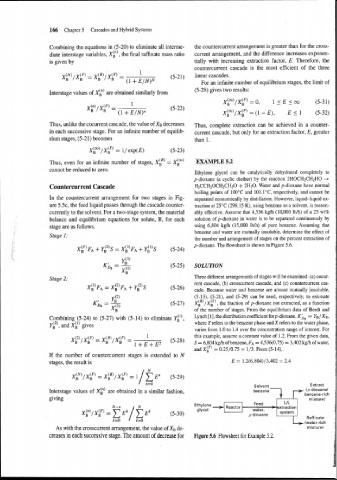
                   creases in each successive stage. The amount of decrease for   Figure 5.6  Flowsheet for Example 5.2.

