


Page 200 - Separation process principles 2
P. 200
5.3  Single-Section, Liquid-Liquid  Extraction Cascades  165


       5.3  SINGLE-SECTION, LIQUID-LIQUID                 For the second stage, a material balance for B gives
  !
       EXTRACTION CASCADES

       Three  possible two-stage, single-section, liquid-liquid  ex-
                                                          with
       yaction cascades are the cocurrent, crosscurrent, and coun-
 $     tercurrent arrangements in  Figure 5.5. The countercurrent
 :     arrangement  is  generally  preferred  because,  as  will  be
  [
       shown in this section, that arrangement results in a higher   Combining (5-17) with (5-18), (5-13), and (5-16) to elimi-
 1     degree of extraction for a given amount of solvent and num-   nate x:),   Yi'), and  Y:)   gives
       her of equilibrium stages.
  [      In Section 4.5, (4-25), for the fraction of solute, B, that is
 E     not extracted, was derived for a single liquid-liquid  equilib-
       rium extraction stage, assuming the use of pure solvent, and
  I                                                       Comparison of  (5-19) with (5-13) shows that xf) = x") B.
 i     a constant value for the distribution coefficient, KbB , for the   Thus,  no  additional  extraction takes  place  in  the  second
       solute, B, dissolved in components A and C, which are mu-
 [     tually insoluble. That equation is now extended to multiple   the first stage are at equilibrium and when they are recon-
                                                          stage. This is as expected because the two streams leaving
 I     stages for each type of cascade shown in Figure 5.5.   tacted in stage 2, no additional net mass transfer of B occurs.
 !     Cocurrent Cascade                                  Accordingly, a cocurrent cascade of equilibrium stages has
 /
                                                          no merit other than to provide increased residence time.

       If  additional stages are added in the cocurrent arrangement
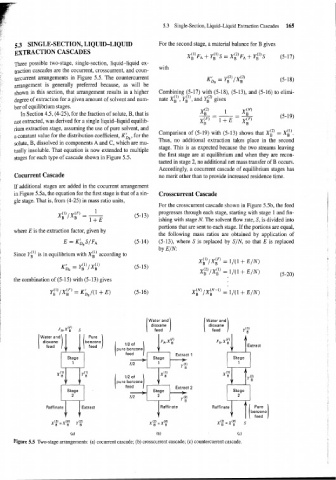
      in Figure 5.5a, the equation for the first stage is that of a sin-   Crosscurrent Cascade
      gle stage. That is, from (4-25) in mass ratio units,
                                                          For the crosscurrent cascade shown in Figure 5.5b, the feed
                                                          progresses through each stage, starting with stage 1 and fin-
                                                          ishing with stage N. The solvent flow rate, S, is divided into
                                                          portions that are sent to each stage. If the portions are equal,
      where E is the extraction factor, given by
                                                          the  following mass  ratios  are  obtained by  application of
                        E  = KbBS/FA             (5-14)   (5-13), where S is replaced by  SIN, so that E is replaced
                                                          by E/N:
      Since Y;)   is in equilibrium with x;)  according to
                                                                        x!'/x~'  = 1/(1 + E/N)
                       KbB  = Y~')/X:'           (5-15)
                                                                        X~"/X;)  = 1/(1+ E/N)
                                                                                                     (5-20)
      the combination of (5- 15) with (5- 13) gives


                                                      Water and  )        Water and  )
                                                     (  dip;;;e           (  dip;;;e   y(l)
                                          (pur~~f;i:eni  /~fi~L~~
                Water and                                                                R
                                                                                         Extract

                         Stage                          Stage                       Stage
                      x(R                     112 of    Stage   Extract 2

                                           pure benzene
                         Stage
                                                                                            y;;;
                                )
                                                         I
                  Raffinate   Extract                     Raffinate          Raffinatn benzene )

                    X(2)   X(R)   y(2)                X(2)   X(Rl             X(2)   X(R)
                     B=  0    B                         B=  B                   B=  B
                          (a)                            (b)                         (c)
      Figure 5.5  Two-stage arrangements: (a) cocurrent cascade; (b) crosscurrent cascade; (c) countercun-ent cascade.

