


Page 202 - Separation process principles 2
P. 202
5.4  Multicomponent Vapor-Liquid  Cascades  167


       Single equilibrium stage                           5.4  MULTICOMPONENT
       ~ll three  arrangements  give  identical  results  for  a  single  stage.   VAPOR-LIQUID  CASCADES
       From (5-13,
                                                          Countercurrent cascades  are  used  extensively  for  vapor-
                                                          liquid separation operations, including absorption, stripping,
                                                          and  distillation.  For  absorption  and  stripping,  a  single-
      The corresponding fractional extraction is          section cascade is used to recover one selected component
                                                          from  the  feed.  For  distillation, a  two-section  cascade  is
                                                          effective in  achieving a  separation between  two  selected
                                                          components referred to  as the key  components. For both
      More than one equilibrium stage                     cases, approximate calculation procedures relate composi-
       (a) Cocurrent  cascade.  For  any  number  of  stages,  the  percent   tions of multicomponent vapor and liquid streams entering
         extraction is the same as for one stage, 70.6%.   and exiting the cascade to the number of equilibrium stages
                                                          required. These  approximate procedures are called  group
       (b)  Crosscurrent  cascade.  For  any  number  of  stages,  (5-21)  ap-
         plies. For example, for two stages, assuming equal flow rates   methods because they provide only an overall treatment of
         of solvent to each stage,                        the  group  of  stages  in  the  cascade,  without  considering
                                                          detailed changes in  temperature, phase compositions, and
                                                          flows from stage to stage.
         and the percent extraction is 79.3%. Results for other numbers
         of stages are obtained in the same manner.       Single-Section Cascades by Group Methods
      (c) Countercurrent  cascade.  For  any  number  of  stages,  (5-29)   Kremser  [2]  originated the  group method by  deriving  an
         applies. For example, for two stages,            equation for the fractional absorption of a species from a gas
                                                          into a liquid absorbent for a multistage countercurrent ab-
                                                          sorber. His method also applies to strippers. The treatment
                                                          presented here is similar to that of Edmister [3] for general
         and the percent extraction is 89.1%. Results for other numbers
         of stages are obtained in the same manner.       application to vapor-liquid  separation operations. An alter-
                                                          native treatment is given by Smith and Brinkley [4].
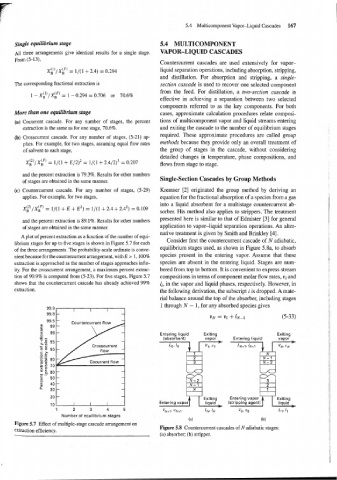
         A plot of percent extraction as a function of the number of equi-
                                                            Consider first the countercurrent cascade of N adiabatic,
      librium stages for up to five stages is shown in Figure 5.7 for each
                                                          equilibrium stages used, as shown in Figure 5.8a, to absorb
      of the three arrangements. The probability-scale ordinate is conve-
      nient because for the countercurrent arrangement, with E r 1, 100%   species present  in  the  entering vapor. Assume  that  these
      extraction is approached as the number of stages approaches infin-   species are absent in the entering liquid. Stages are num-
      ity. For the crosscurrent arrangement, a maximum percent extrac-   bered from top to bottom. It is convenient to express stream
      tion of 90.9% is computed from (5-23). For five stages, Figure 5.7   compositions in terms of component molar flow rates, vi and
      shows that the countercurrent  cascade has already achieved 99%   li, in the vapor and liquid phases, respectively. However, in
      extraction.                                         the following derivation, the subscript i is dropped. A mate-
                                                          rial balance around the top of the absorber, including stages
                                                          1 through N - 1, for any absorbed species gives
                           I     I     I
                     -                      -
                     -                      -
                           Countercurrent flow
                                                          Entering liquid   Exiting                Exiting
                                                           (absorbent)    vapor     Entering liquid   vapor
                                  Crosscurrent

                                                                                              N- I
                                 Cocurrent flow                                               N-2
                     -                      -
                     -                      -
                     -                      -
                     -                      -
                   20  -                    -                            Exiting   Entering vapor   Exiting
                   10      I     I     I                  Entering vapor In' liquid  >  (stripping agentn'' liquid  +
                     1     2     3     4     5             VN+l, UN+1    LN, IN       vo, uo        Ll, 11
                       Number of equilibrium stages
                                                                    (a)                      (b)
      Figure 5.7  Effect of multiple-stage cascade arrangement on
                                                          Figure 5.8  Countercurrent cascades of N adiabatic stages:
      extraction efficiency.
                                                          (a) absorber; (b) stripper.

