


Page 199 - Separation process principles 2
P. 199
164  Chapter 5  Cascades and Hybrid Systems


                    By back-substitution, interstage values of X are given by   solvent feed rate, S, a large number of stages, N, and/or by
                                                                        employing a large washing factor, which can be  achieved
                                              N -n
                                                                        by minimizing the amount of liquid underflow compared to
                                                               (5-1 1)   overflow. It should be noted that the minimum amount of sol-
                                                                        vent required corresponds to zero overflow from stage 1, or
                                              \      I
                    For example, with N = 5,
                        XI = YI  = (?) (                                For this minimum value, W = 1 from (5-5) and all soluble
                                         1+w+w2+w3+w4
                                                                        solids leave in the underflow from the last stage, N, regard-
                                                  W4
                                                                        less of the number of stages. Therefore, it is best to specify a
                       The purpose of the cascade, for any given S, is to maxi-   value of  S significantly greater than S,,.   Equations (5-10)
                    mize Y1, the amount of soluble solids dissolved in the sol-   and (5-5) show that the value of XN is reduced exponentially
                    vent leaving in the overflow from stage 1, and to minimize   by increasing the number of stages, N. Thus, the countercur-
                    XN, the amount of soluble solid dissolved in the solvent leav-   rent cascade can be very effective. For two or more stages,
                    ing the underflow with the insoluble material from stage N.   XN is also reduced exponentially by  increasing the solvent
                    Equation (5-10) indicates that  this  can  be  achieved  for a   rate, S. For three or more stages, the value of XN is reduced
                    given  soluble-solids feed  rate,  FB, by  specifying a  large   exponentially by decreasing the underflow ratio R.


                     EXAMPLE 5.1
                    Pure water is to be  used to dissolve  1,350 kgih of  Na2C03 from   The percent recovery of soluble material is
                    3,750 kgih of  a solid, where the balance is an insoluble oxide. If   yI(s - RFA)/FB = y1[4,000 - (2/3)(2,400)]/1,350  100%
                    4,000 kglh of water is used as the solvent for the carbonate and the
                    total underilow from each stage is 40 wt% solvent on a solute-free   = 177.8Y1                   (3)
                    basis, compute and plot the percent recovery of the carbonate in the   Results for one to five stages, as computed from (1) to (3), are
                    overflow product for one stage and for two to five countercurrent
                                                                       No. of Stages                      Percent Recovery
                    stages, as in Figure 5.3.
                                                                       in Cascade, N    XN        YI      of Soluble Solids
                    SOLUTION

                    Soluble solids feed rate = FB = 1,350 kgih
                    Insoluble  solids  feed  rate = FA = 3,750 - 1,350 = 2,400 kgih   5   0.00864   0.5567     99.0
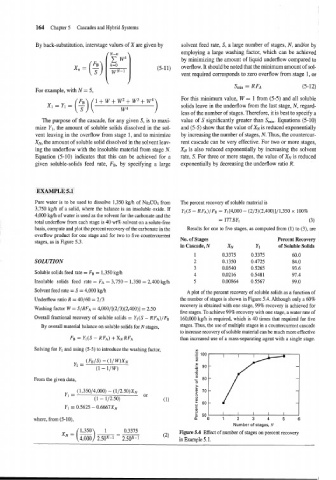
                    Solvent feed rate = S = 4,000 kgih                    A plot of the percent recovery of soluble solids as a function of
                    Underflow ratio R = 40160 = 213                    the number of stages is shown in Figure 5.4. Although only a 60%
                                                                       recovery is obtained with one stage, 99% recovery is achieved for
                    Washing factor W = SIRFA = 4,000/[(2/3)(2,400)] = 2.50
                                                                       five stages. To achieve 99% recovery with one stage, a water rate of
                    Overall fractional recovery  of soluble solids = Yi(S - RFA)/FB   160,000 kgih is required, which is 40 times that required for five
                      By overall material balance on soluble solids for N stages,   stages. Thus, the use of multiple stages in a countercurrent cascade
                                                                       to increase recovery of soluble material can be much more effective
                                FB = Yl(S - RFA) +XNRFA                than increased use of a mass-separating agent with a single stage.
                    Solving for Y1 and using (5-5) to introduce the washing factor,   ~1
                                                                             E  100
                                      (FB/S) - (l/W)XN
                                  Yl =
                                          (1 - l/W)
                    From the given data,


                                                                             4  50
                    where, from (5-lo),                                     a  o      I    2     3    4    5     6
                                                                                          Number of stages, N
                                                                       Figure 5.4 Effect of number of stages on percent recovery
                                                                 (2)
                                                                       in Example 5.1.

