


Page 195 - Separation process principles 2
P. 195
160  Chapter 4  Single Equilibrium Stages and Flash Calculations


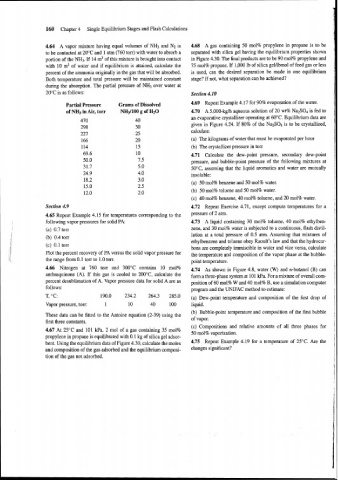
                  4.64  A vapor mixture  having  equal volumes  of  NH3 and N2 is   4.68  A gas containing  50 mol%  propylene in propane  is to be
                  to be contacted at 20°C and 1 atm (760 tom) with water to absorb a   separated with silica gel having the equilibrium properties shown
                  portion of the NH3. If  14 m3 of this mixture is brought into contact   in Figure 4.30. The final products are to be 90 mol% propylene and
                  with  10 m3 of  water and if  equilibrium  is attained, calculate the   75 mol% propane. If 1,000 lb of silica geMbmol of feed gas or less
                  percent of the ammonia originally in the gas that will be absorbed.   is used,  can  the  desired  separation  be  made  in  one equilibrium
                  Both temperature  and total  pressure  will be  maintained constant   stage? If not, what separation can be achieved?
                  during the absorption. The partial pressure  of NH3 over water at
                  20°C is as follows:                                Section 4.10

                         Partial Pressure   Grams of Dissolved       4.69  Repeat Example 4.17 for 90% evaporation of the water.
                         of NH3 in Air, torr   NHd100 g of Hz0       4.70  A 5,000-kglh aqueous solution of 20 wt% Na2S04 is fed to
                                                                     an evaporative crystallizer operating at 60°C. Equilibrium data are
                                                                     given in Figure 4.24. If 80% of the Na2S04 is to be crystallized,
                                                                     calculate:
                                                                     (a) The kilograms of water that must be evaporated per hour
                                                                     (b)  The crystallizer pressure in ton
                                                                     4.71  Calculate  the  dew-point  pressure,  secondary  dew-point
                                                                     pressure,  and bubble-point pressure  of  the following mixtures  at
                                                                     50°C, assuming that the liquid aromatics and water are mutually
                                                                     insoluble:
                                                                     (a)  50 mol% benzene and 50 mol% water.
                                                                     (b)  50 mol% toluene and 50 mol% water.
                                                                     (c)  40 mol% benzene, 40 mol% toluene, and 20 mol% water.
                  Section 4.9                                        4.72  Repeat Exercise 4.71,  except  compute  temperatures  for a
                  4.65 Repeat Example 4.15 for temperatures corresponding to the   pressure of 2 atrn.
                  following vapor pressures for solid PA:            4.73  A liquid containing 30 mol%  toluene, 40 mol% ethylben-
                  (a)  0.7 torr                                      zene, and 30 mol% water is subjected to a continuous, flash distil-
                                                                     lation  at a total pressure  of  0.5  atm. Assuming  that  mixtures  of
                  (b)  0.4 torr
                                                                     ethylbenzene and toluene obey Raoult's  law and that the hydrocar-
                  (c)  0.1 torr
                                                                     bons are completely immiscible in water and vice versa, calculate
                  Plot the percent recovery of PA versus the solid vapor pressure for
                                                                     the temperature and composition of the vapor phase at the bubble-
                  the range from 0.1 torr to 1.0 torr.               point temperature.
                  4.66  Nitrogen  at  760  torr  and  300°C  contains  10  mol%   4.74  As shown in Figure 4.8, water (W) and n-butanol (B) can
                  anthraquinone  (A). If  this  gas is cooled  to 200°C, calculate  the
                                                                     form a three-phase system at 101  kPa. For a mixture of overall com-
                  percent desublimation of A. Vapor pressure data for solid A are as
                                                                     position of 60 mol% W and 40 mol% B, use a simulation computer
                  follows:
                                                                     program and the UNIFAC method to estimate:
                  T, "C:             190.0    234.2   264.3   285.0   (a)  Dew-point  temperature  and  composition of  the  first drop of
                  Vapor pressure, torr:   1    10      40    100     liquid.
                                                                     (b)  Bubble-point temperature and composition of the first bubble
                  These data can be fitted to the Antoine equation (2-39) using the
                                                                     of vapor.
                  first three constants.
                                                                     (c)  Compositions  and  relative  amounts  of  all  three  phases  for
                  4.67 At 25°C and  101 kPa, 2 mol of  a gas containing  35 mol%
                                                                     50 mol% vaporization.
                  propylene in propane is equilibrated with 0.1 kg of silica gel adsor-
                  bent. Using the equilibrium data of Figure 4.30, calculate the moles   4.75  Repeat Example 4.19 for a temperature of  25°C. Are the
                  and composition of the gas adsorbed and the equilibrium composi-   changes significant?
                  tion of the gas not adsorbed.

