


Page 190 - Separation process principles 2
P. 190
Exercises   155


      (b) When   a solution containing 40 mol%  isopropanol is slowly   of  Table 4.4.
      vaporized,  what  will  be  the  composition  of  the  initial  vapor
                                                                  xi  = (1 - Kdl(K1 - K2)
      formed?
      (c)  If  this same 4.0% mixture is heated under equilibrium  condi-   X2 = 1 - X1
                                                                  .
      tions until 75 mol% has been vaporized, what will be the composi-   YI  = (K1K2 - Ki)I(K2 - Ki)
      tions of the vapor and liquid produced?
                                                                  y2  = 1 - y1
      VAPOR-LIQUID  EQUILIBRIUM FOR ISOPROPANOL                     =   = z~[(Ki - Kz)/(l  - K2)l - 1
                                                                      F           K1 - 1
      AND WATER AT 1 ATM
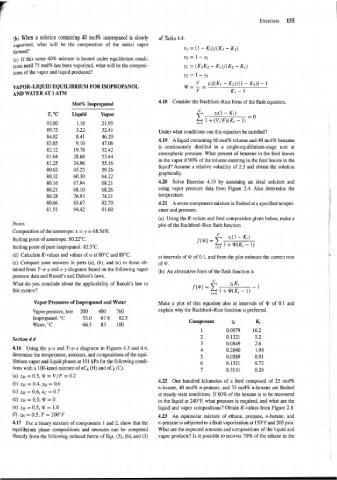
                                                         4.18  Consider the Rachford-Rice  form of the flash equation,
                           Mol% Isopropanol
                           Liquid    Vapor
                            1.18     2 1.95
                            3.22     32.41               Under what conditions can this equation be satisfied?       I
                            8.41     46.20
                                                         4.19  A liquid containing 60 mol% toluene and 40 mol% benzene
                            9.10     47.06
                           19.78     52.42               is  continuously  distilled  in  a  single-equilibrium-stage  unit  at   I
                                                         atmospheric pressure. What percent of benzene in the feed leaves
                           28.68     53.44
                                                         in the vapor if 90% of the toluene entering in the feed leaves in the
                           34.96     55.16
                           45.25     59.26               liquid? Assume a relative volatility of 2.3 and obtain the solution
                                                         graphically.
                           60.30     64.22
                                                         4.20  Solve  Exercise  4.19  by  assuming  an  ideal  solution  and
                                                         using  vapor  pressure  data  from Figure  2.4. Also  determine the
                                                         temperature.
                                                         4.21  A seven-component mixture is flashed at a specified temper-
                                                         ature and pressure.
                                                         (a)  Using the K-values and feed composition given below, make a
      Notes:                                             plot of the Rachford-Rice  ilash function
      Composition of the azeotrope: x = y = 68.54%.
      Boiling point of azeotrope: 80.22"C.
      Boiling point of pure isopropanol: 82.5"C.
      (d)  Calculate K-values and values of a at 80°C and 89°C.   of ..
                                                         at intervals of 9 of 0.1, and from the plot estimate the correct root
      (e)  Compare your answers in parts  (a), (b), and (c) to those ob-
      tained from T-x-y  and x-y  diagrams based on the following vapor   (b)  An alternative form of the flash function is
      pressure data and Raoult's and Dalton's laws.
      What do you  conclude about the applicability of Raoult's  law to
      this system?
             Vapor Pressures of Isopropanol and Water    Make  a  plot  of  this  equation  also  at  intervals  of  \I,  of  0.1 and
             Vapor pressure, torr   200   400   760      explain why the Rachford-Rice  function is preferred.
             Isopropanol, "C   53.0   67.8   82.5
                                                                    Component
             Water, "C        66.5   83   100
                                                                        1
                                                                        2
      Section 4.4
                                                                        3
      4.16  Using the y-x  and  T-y-x  diagrams in Figures 4.3 and 4.4,   4
      determine the temperature, amounts, and compositions of the equi-   5
      librium vapor and liquid phases at 101 kPa for the following condi-
                                                                        6
      tions with a 100-kmol mixture of nC6 (H) and nC8 (C).             7
      (a)  ZH = 0.5, QJ = V/F = 0.2
                                                         4.22  One hundred  kilomoles  of  a  feed  composed  of  25 mol%
      (b)  ZH  = 0.4, YH  = 0.6
                                                         n-butane, 40 mol% n-pentane, and 35 mol% n-hexane are flashed
      (c)  ZH  = 0.6. xc = 0.7
                                                         at steady-state conditions. If  80% of the hexane is to be recovered
      (d)  ZH = 0.5, q = 0                               in the liquid at 240°F, what pressure is required, and what are the
      (e) zH = 0.5, \V  = 1.0                            liquid and vapor compositions?  Obtain K-values from Figure 2.8.
      (f)  ZH = 0.5, T = 20PF                            4.23  An  equimolar  mixture  of  ethane,  propane,  n-butane,  and
      4.17  For a binary mixture of components  1 and 2, show that the   n-pentane is subjected to a flash vaporization at 150°F and 205 psia.
      equilibrium  phase  compositions  and  amounts  can  be  computed   What are the expected amounts and compositions of the liquid and
      directly from the following reduced forms of Eqs. (5), (6), and (3)   vapor products? Is it possible to recover 70% of the ethane'in the

