


Page 186 - Separation process principles 2
P. 186
Summary  151

                Start                                     EXAMPLE 4.19
               F, z fixed
         '   p,  T of equilibrium                         In a process for producing styrene from toluene and methanol, the
             phases fixed
                                                          gaseous reactor effluent is as follows:
                                                                        Component     kmoyh
              three-phase                                               Hydrogen       350
                                                                        Methanol       107
          Solution                                                      Water          49 1
          not found                                                     Toluene        107
                                                                        Ethylbenzene   141
                                                                        Styrene        350
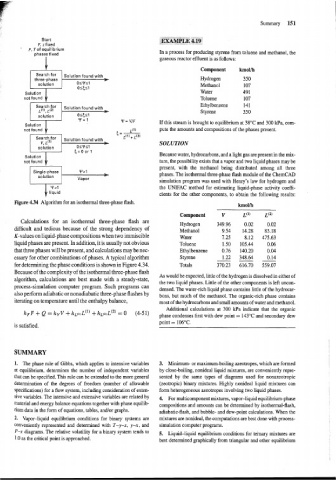
                                            Y = VIF       If this stream is brought to equilibrium at 38°C and 300 @a,  com-
          Solution
          not found                                       pute the amounts and compositions of the phases present.

                                                          SOLUTION
            -                                             Because water, hydrocarbons, and a light gas are present in the mix-

          not found                                       ture, the possibility exists that a vapor and two liquid phases may be

             Single-phase                                 present,  with  the  methanol  being  distributed  among  all  three
               solution                                   phases. The isothermal three-phase flash module of the ChemCAD
                                                          simulation program was used with Henry's  law for hydrogen  and
                                                          the  UNIFAC method  for estimating  liquid-phase  activity  coeffi-
                 I '"                                     cients  for the other components,  to obtain  the following results:
                   liquid
      Figure 4.34  Algorithm for an isothermal three-phase flash.
                                                                                     kmoyh
                                                                 Component      V      1  )    ~(2)
         Calculations  for  an  isothermal  three-phase  flash  are
                                                                 Hydrogen     349.96    0.02    0.02
      difficult  and tedious because  of the strong dependency  of
                                                                 Methanol       9.54   14.28   83.18
      K-values on liquid-phase compositions when two immiscible   Water         7.25    8.12   475.63
      liquid phases are present. In addition, it is usually not obvious   Toluene   1.50   105.44   0.06
      that three phases will be present, and calculations may be nec-   Ethylbenzene   0.76   140.20   0.04
                                                                                      348.64
                                                                                                0.14
                                                                                1.22
      essary for other combinations of phases. A typical algorithm   Styrene   ---
      for determining the phase conditions is shown in Figure 4.34.   Totals   370.23   616.70   559.07
      Because of the complexity of the isothermal three-phase flash
                                                          As would be expected, little of the hydrogen is dissolved in either of
      algorithm,  calculations  are best  made with  a  steady-state,
                                                          the two liquid phases. Little of the other components is left uncon-
      process-simulation  computer program. Such programs can
                                                          densed. The water-rich liquid phase contains little of the hydrocar-
      also perform adiabatic or nonadiabatic three-phase flashes by
                                                          bons, but much of the methanol. The organic-rich phase contains
      iterating on temperature until the enthalpy balance,   most of the hydrocarbons and small amounts of water and methanol.
                                                            Additional  calculations  at  300 kPa  indicate  that  the  organic
                                                          phase condenses first with dew point = 143°C and secondary dew
                                                          point = 106°C.
      is satisfied.


      SUMMARY

      1.  The phase rule of Gibbs, which applies to intensive variables   3.  Minimum- or maximum-boiling azeotropes, which are formed
      at  equilibrium,  determines  the  number  of  independent  variables   by close-boiling, nonideal liquid mixtures, are conveniently repre-
      that can be specified. This rule can be extended to the more general   sented  by  the  same  types  of  diagrams  used  for  nonazeotropic
      determination  of  the  degrees  of  freedom  (number  of  allowable   (zeotropic) binary  mixtures. Highly nonideal  liquid mixtures  can
      specifications) for a flow system, including consideration of exten-   form heterogeneous azeotropes involving two liquid phases.
      sive variables. The intensive and extensive variables are related by   4.  For multicomponent mixtures, vapor-liquid  equilibrium-phase
      material and energy balance equations together with phase equilib-
                                                          compositions and amounts can be determined by isothermal-flash,
      rium data in the form of equations, tables, andlor graphs.
                                                          adiabatic-flash, and bubble- and dew-point calculations. When the
      2.  Vapor-liquid  equilibrium  conditions for  binary  systems  are   mixtures are nonideal, the computations are best done with process-
      conveniently represented  and determined  with  T-y-x,  y-x,  and   simulation computer programs.
       P-n  diagrams. The relative volatility for a binary system tends to
                                                          5.  Liquid-liquid  equilibrium conditions for ternary mixtures are   I
       1.0 as the critical point is approached.           best determined graphically from triangular and other equilibrium

