


Page 184 - Separation process principles 2
P. 184
4.10  Multiphase Systems  149


       Hence                                              SOLUTION
                   XH~O = 51.6/(51.6 + 4.3) = 0.923       (a)  Initial  phase  conditions  are  T= 136°C = 276.8"F  and
                                                             P = 133.3 kPa = 19.34 psia. Vapor pressures at 276.8"F and
       BY Raoult's law, p~,o = P = 4.74(0.923) = 4.38 psia
                                                             Pizo = 46.7  psia  and  Pic, = 19.5 psia. Because  the initial
                                                             pressure is less than the vapor pressure of each component, the
                                                             initial phase condition is all vapor, with partial pressures
       Approximate Method for a
       Vapor-Liquid-Liquid  System                                PH,O  = YH~O P = 0.75(19.34) = 14.5 psia

       Another case suitable for an approximate method is that of a   PnCs = ync8P = 0.25(19.34) = 4.8 psia
       mixture containing water and hydrocarbons (HCs), at condi-
                                                          (b) As  the  temperature  is  decreased,  the  first  phase  change
       tions such that a vapor phase and two liquid phases, HC-rich   occurs when  a temperature is reached  where either PAzo =
       (1) and water-rich (2) coexist. Often the solubilities of water   PH,O  = 14.5 psia or Pic8 = pncs = 4.8 psia. The correspond-
       in the liquid HC phase and HCs in the water phase are less   ing temperatures where these vapor pressures occur are 21 1°F
       than 0.1 mol% and may be neglected. In that case, if the liq-   for H20 and  194°F for nC8. The highest temperature applies.
       uid HC phase obeys Raoult's  law, the total pressure of  the   Therefore, water condenses first when the temperature reaches
       system is given by the sum of the pressures exhibited by the   211°F. This is the dew-point temperature of the initial mixture
       separate phases:                                      at the system pressure. As the temperature is further reduced,
                                                             the number of moles of  water in the vapor decreases, causing
                                                             the partial pressure of water to decrease below 14.5 psia and the
                                                             partial pressure of  nC8 to increase above 4.8 psia. Thus, nC8
                                                             begins to condense, forming a second liquid phase, at a tem-
       For more general cases, at low pressures where the vapor   perature higher than 194°F but lower than 211°F. This temper-
       phase is ideal but the liquid HC phase may be nonideal,   ature, referred to as the secondary dew point, must be deter-
                                                             mined iteratively. The calculation is simplified if  the bubble
                                                             point of the mixture is computed first.
                    P  = P&20 + P   K~X;')
                                HCs                       From (4-34),
       which can be rearranged to                                      P = 19.34psi = Pizo + Pic,      (1)

                                                          Thus, a temperature is sought, as follows, to cause Eq. (1) to be
                                                          satisfied:

                                                                            psia
      Equations (4-34) and (4-36) can be used directly to estimate   T, OF   PH~o,  Ec,, psia   P, psis
      the pressure for a given temperature and liquid-phase com-   194    10.17      4.8      14.97
      position or iteratively to estimate the temperature for a given   202   12.01   5.6     17.61
      pressure. An important aspect of the calculation is the deter-   206   13.03   6.1      19.13
      mination of the particular phases present from all six possi-   207   13.30    6.2      19.50
      ble  cases,  namely,  V,  V-L('),  v-L(')-L(~), v-L(~),
                                                          By linear interpolation,  T = 206.7"F for P = 19.34 psia. Below this
      L(')-L(~),  and L. It is not always obvious how  many  and
                                                          temperature, the vapor phase disappears and only two immiscible
      which phases may be present. Indeed, if a v-L(')-L(~) solu-
                                                          liquid phases are present.
      tion to a problem exists, almost always V-L(') and v-L(~)
                                                            To determine the temperature at which one of the liquid phases
      solutions also exist. In that case, the three-phase solution is   disappears, which is the same condition as when the second liquid
      the correct one. It is important, therefore, to seek the three-   phase begins to appear (secondary dew point), it is noted for this
      phase solution first.                               case, with only pure water and a pure HC present, that vaporization
                                                          starting from the bubble point is at a constant temperature until one
                                                          of  the two liquid phases is completely vaporized. Thus, the sec-
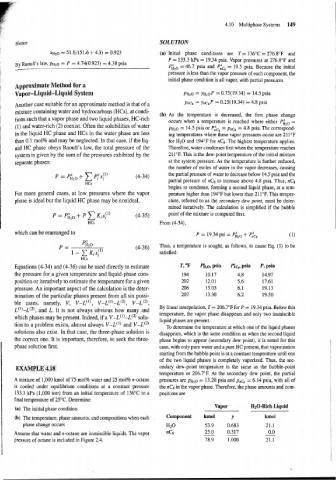
       EXAMPLE 4.18                                       ondary  dew-point  temperature is  the  same  as  the  bubble-point
                                                          temperature or 206.7"F. At  the  secondary dew  point, the partial
      A mixture of  1,000 kmol of 75 mol% water and 25 mol% n-octane   pressures are PH~O = 13.20 psia and p,~, = 6.14 psia, with all of
      is  cooled  under  equilibrium conditions  at  a  constant  pressure   the nC8 in the vapor phase. Therefore, the phase amounts and com-
       133.3 kPa (1,000 torr) from an initial temperature of  136°C to a   positions are
      final temperature of 25°C. Determine:
                                                                             Vapor        H20-Rich Liquid
       (a) The initial phase condition
       (b)  The temperature, phase amounts, and compositions when each   Component   kmol   Y   kmol
         phase change occurs
      Assume that water and n-octane are immiscible liquids. The vapor
      pressure of octane is included in Figure 2.4.

