


Page 189 - Separation process principles 2
P. 189
154  Chapter 4  Single Equilibrium Stages and Flash Calculations

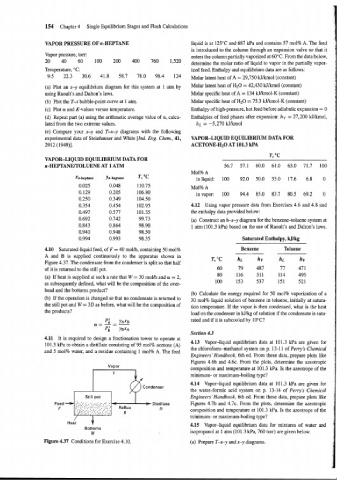
                 VAPOR PRESSURE OF n-HEPTANE                         liquid is at 125°C and 687 kPa and contains 57 mol% A. The feed
                                                                     is introduced to the column through an expansion valve so that it
                 Vapor pressure, tom:                                enters the column partially vaporized at 60°C. From the data below,
                 20    40    60    loo   200    400   760            determine the molar ratio of liquid to vapor in the partially vapor-
                 Temperature, "C:                                    ized feed. Enthalpy and equilibrium data are as follows:
                  9S    22.3   30.6   41.8   58.7   78.0   98.4   124   Molar latent heat of A = 29,750 Who1 (constant)
                 (a)  Plot  an x-y  equilibrium diagram for this system at  1 atm by   Molar latent heat of Hz0 = 42,430 Wflunol (constant)
                 using Raoult's and Dalton's laws.                   Molar specific heat of A = 134 kJ/kmol-K (constant)
                 (b)  Plot the T-x  bubble-point curve at 1 atm.     Molar specific heat of H20 = 75.3 kJ/kmol-K (constant)
                 (c)  Plot a and K-values versus temperature.        Enthalpy of high-pressure, hot feed before adiabatic expansion = 0
                 (d)  Repeat part (a) using the arithmetic average value of a, calcu-   Enthalpies of  feed phases after expansion: hv = 27,200 Whol,
                 lated from the two extreme values.                   hL = -5,270  Who1
                 (e) Compare  your  x-y  and  T-x-y  diagrams  with  the  following
                 experimental data of Steinhauser and White [Ind. Eng. Chem., 41,   VAPOR-LIQUID  EQUILIBRIUM DATA FOR
                 2912 (1949)l.                                       ACETONE-H20 AT 101.3 kPA
                                                                                                T, "C
                 VAPOR-LIQUID  EQUILIBRIUM DATA FOR
                 n-HEPTANElTOLUENE AT 1 ATM                                     56.7   57.1  60.0   61.0   63.0  71.7   100
                                                                     Mol% A
                                                                      in liquid:   100   92.0  50.0   33.0   17.6   6.8   0
                                                                     Mol% A
                                                                      in vapor:   100   94.4   85.0  83.7   80.5  69.2   0

                                                                     4.12  Using vapor pressure data from Exercises 4.6  and 4.8 and
                                                                     the enthalpy data provided below:
                                                                     (a)  Construct an h-x-y  diagram for the benzene-toluene  system at
                                                                     1 atm (101.3 kPa) based on the use of Raoult's  and Dalton's laws.
                                                                                       Saturated Enthalpy, kJ/kg
                 4.10  Saturated-liquid feed, of F = 40 mom, containing 50 mol%       Benzene        Toluene
                 A  and  B  is  supplied  continuously  to  the  apparatus  shown  in   T, "C   h~   hv   h~   hv
                 Figure 4.37. The condensate from the condenser is split so that half
                 of it is returned to the still pot.
                 (a)  If heat is supplied at such a rate that W = 30 molh and a = 2,
                 as subsequently defined, what will be the composition of the over-
                 head and the bottoms product?
                                                                     (b)  Calculate the energy required for 50 mol%  vaporization of  a
                 (b)  If the operation is changed so that no condensate is returned to   30 mol% liquid solution of benzene in toluene, initially at satura-
                 the still pot and W = 30 as before, what will be the composition of
                                                                    tion temperature. If the vapor is then condensed, what is the heat
                 the products?
                                                                    load on the condenser in kJkg of solution if the condensate is satu-
                                                                    rated and if it is subcooled by  10°C?
                                                                    Section 4.3
                 4.11  It is required to design a fractionation tower to operate at
                                                                    4.13  Vapor-liquid  equilibrium data  at  101.3 kPa  are given  for
                 101.3 kPa to obtain a distillate consisting of 95 mol% acetone (A)
                                                                    the chloroforn-methanol  system on p. 13-11 of Perry's Chemical
                 and 5 mol% water, and a residue containing 1 mol% A. The feed
                                                                    Engineers'Handbook, 6th ed. From these data, prepare plots like
                                                                    Figures 4.6b  and 4.6~. From the plots, determine the azeotropic
                                       Vapor
                                                                    composition and temperature at 101.3 kPa. Is the azeotrope of the
                                                                    minimum- or maximum-boiling type?
                                                                    4.14  Vapor-liquid  equilibrium data  at  101.3 kPa  are given for
                                               (jc Condenser        the  water-formic  acid  system on  p.  13-14 of  Perry's  Chemical
                                       ;'PA>                        Engineers'Handbook, 6th ed. From these data, prepare plots like
                                .
                                   ...
                     ~eed qf7:.;',?.;:::: and 4.7~. From the plots,  determine the azeotropic
                                                                          4.7b
                                    .
                                       ...
                                                                    Figures
                                    .
                                      :.
                                     .-
                                  ,
                                 ..
                                      ,
                                                       Distillate
                                  ,
                                      ..-2
                                ,_
                      F     .  : .  ;;;;,.:.:   Reflux   D          composition and temperature at 101.3 kPa. Is the azeotrope of the
                            :. '  .*., , -, : .;.  , ;,. ,'. . .'..   R
                                                                    minimum- or maximum-boiling type?
                                                                    4.15  Vapor-liquid  equilibrium  data  for  mixtures  of  water  and
                               Bottoms
                                 W                                  isopropanol at 1 atm (101.3 kPa, 760 torr) are given below.
                 Figure 4.37  Conditions for Exercise 4.10.         (a)  Prepare T-x-y  and x-y  diagrams.

