


Page 193 - Separation process principles 2
P. 193
158  Chapter 4  Single Equilibrium Stages and Flash Calculations

                                                                      1 wt% acetic acid. The following four solvents, with accompanying
                                                                      distribution coefficients in mass-fraction  units,  are being  consid-
                                                                      ered. Water and each solvent (C) can be considered immiscible. For
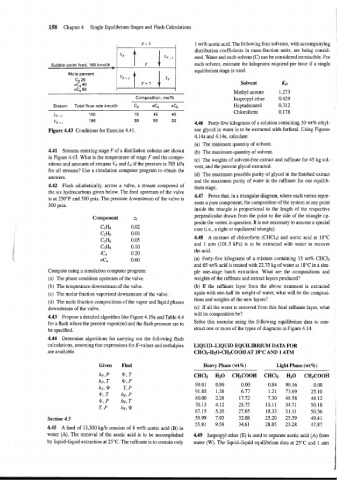
                   Bubble-point feed, 160 kmollh -   IFt              each solvent, estimate the kilograms required per hour if  a single
                                         - I
                                                                      equilibrium stage is used.
                         Mole percent
                            C,  20
                            nC,  40                                                   Solvent        KD
                            nC,  50
                                                                                    Methyl acetate   1.273
                                                 Composition,  mol%                 Isopropyl ether   0.429
                    Stream   Total flow rate kmollh   C3   nC4   nC5                Heptadecanol    0.312
                                                                                    Chloroform      0.178

                                                                      4.46  Forty-five kilograms of a solution containing 30 wt% ethyl-
                  Figure 4.43  Conditions for Exercise 4.41.          ene glycol in water is to be extracted with furfural. Using Figures
                                                                      4.14a and 4.14e, calculate:
                                                                      (a)  The minimum quantity of solvent.
                  4.41  Streams entering stage F of a distillation column are shown   (b)  The maximum quantity of solvent.
                  in Figure 4.43. What is the temperature of stage F and the compo-
                                                                      (c)  The weights of solvent-free extract and raffinate for 45 kg sol-
                  sitions and amounts of streams VF and LF if the pressure is 785 kPa   vent, and the percent glycol extracted.
                  for all streams? Use a simulation computer program to obtain the
                                                                      (d)  The maximum possible purity of glycol in the finished extract
                  answers.
                                                                      and the maximum purity of water in the raffinate for one equilib-
                  4.42  Flash adiabatically, across  a valve, a  stream  composed of   rium stage.
                  the six hydrocarbons given below. The feed upstream of the valve
                                                                      4.47  Prove that, in a triangular diagram, where each vertex repre-
                  is at 250°F and 500 psia. The pressure downstream of the valve is
                                                                      sents a pure component, the composition of the system at any point
                  300 psia.
                                                                      inside the triangle is proportional  to  the length of  the respective
                                                                      perpendicular drawn from the point to the side of the triangle op-
                                  Component      Zi
                                                                      posite the vertex in question. It is not necessary to assume a special
                                                                      case (i.e., a right or equilateral triangle).
                                                                      4.48  A mixture of chloroform (CHC13) and acetic acid at  18OC
                                                                      and  1 atm (101.3  kPa)  is to be  extracted  with  water  to  recover
                                                                      the acid.
                                                                      (a)  Forty-five kilograms of  a mixture containing 35 wt% CHC13
                                                                      and 65 wt% acid is treated with 22.75 kg of water at 18OC in a sim-
                  Compute using a simulation computer program:        ple  one-stage  batch  extraction.  What  are  the  compositions  and
                  (a)  The phase condition upstream of the valve.     weights of the raffinate and extract layers produced?
                  (b)  The temperature downstream of the valve.       (b)  If  the  raffinate  layer  from  the  above  treatment  is  extracted
                  (c)  The molar fraction vaporized downstream of the valve.   again with one-half its weight of  water, what will be the composi-
                                                                      tions and weights of the new layers?
                  (d)  The mole fraction compositions of the vapor and liquid phases
                  downstream of the valve.                            (c)  If all the water is removed from this final raffinate layer, what
                                                                      will its composition be?
                  4.43  Propose a detailed algorithm like Figure 4.19a and Table 4.4
                  for a flash where the percent vaporized and the flash pressure are to   Solve this  exercise using the following  equilibrium  data  to con-
                  be specified.                                       struct one or more of the types of diagrams in Figure 4.14.
                  4.44  Determine  algorithms  for carrying out the following  flash
                  calculations, assuming that expressions for K-values and enthalpies   LIQUID-LIQUID  EQUILIBRIUM DATA FOR
                  are available.                                      CHClj-HzO-CH3COOH AT 18°C AND 1 ATM

                                    Given   Find                         Heavy Phase (wt%)         Light Phase (wt%)
                                                                                              CHClj   HzO    CH3COOH
                                                                                                0.84   99.16    0.00
                                                                                                1.21   73.69   25.10
                                                                                                7.30   48.58   44.12
                                                                                               15.11   34.71   50.18
                                                                                               18.33   31.11   50.56
                  Section 4.5                                                                  25.20   25.39   49.4.1
                                                                                               28.85   23.28   47.87   i
                  4.45  A feed of  13,500 kgh consists of  8 wt% acetic acid (B) in                                    1
                  water  (A). The removal  of the acetic acid is to be accomplished   4.49  Isopropyl ether (E) is used to separate acetic acid (A) from
                  by liquid-liquid  extraction at 25OC. The raffinate is to contain only   water (W). The liquid-liquid  equilibrium  data at 25OC  and 1 atm

