


Page 198 - Separation process principles 2
P. 198
5.2  Solid-Liquid Cascades  163


       developed in subsequent chapters. As  will be  seen, single   Assuming equilibrium, the concentration of soluble ma-
              cannot be obtained from rigorous models because   terial in the overflow from each stage is equal to the concen-
       of the nonlinear nature of rigorous models, malung computer   tration of soluble material in the liquid part of the underflow
       calculations a necessity.                          from the same stage. Thus,


       5.2  SOLID-LIQUID  CASCADES
                                                          In addition, it is convenient to define a washing factol; W, as
       Consider  the  N-stage,  countercurrent  leaching-washing
       process shown in Figure 5.3. This cascade is an extension of
       the single-stage systems discussed in Section 4.7. The solid
       feed, entering stage 1, consists of two components A and B,
                                                            If (5-I), (5-2), and (5-3) are each combined with (5-4) to
       of mass flow rates FA and FB. Pure liquid solvent, C, which
                                                          eliminate  Y, and the resulting equations are rearranged to
       can dissolve B completely, but not A at all, enters stage N at
                                                          allow the substitution.of (5-3, the following equations result:
       a mass flow rate S. Thus, A passes through the cascade as an
       insoluble solid. It is convenient to express liquid-phase  con-
       centrations of B, the solute, in terms of mass ratios of solute
       to solvent. The liquid oveg7ow from each stage, j, contains 5
       mass of soluble material per mass of solute-free solvent, and
       no insoluble material. The underJlow from each stage is a
       slurry consisting of  a mass flow FA of  insoluble solids, a
       constant ratio of  mass of  solvent/mass of  insoluble solids
       equal to R, and 4 mass of  soluble materiallmass of solute-
       free solvent. For a given solid feed, a relationship between
       the exiting underflow concentration of  the soluble compo-   Equations (5-6) to (5-8) constitute a set of N linear alge-
       nent, XN, the solvent feed rate, and the number of stages is   braic equations in N unknowns, X,(n  = 1 to N). The equa-
      derived as follows.                                 tions are of  a tridiagonal, sparse-matrix form, which-for
         If  equilibrium is  achieved  at  each  stage, the  overflow   example, with N = 5-is   given by
       solute concentration, Yj, equals the underflow solute concen-   -
       tration in the liquid, Xi,  which refers to liquid held by  the   1   - 1   0   0       0
       solid in the underflow. Assume that all soluble material, A,  is   () - (  )  1   0     0
      dissolved or leached in stage 1 and all other stages are then
      washing stages for reducing the amount of soluble material   0   (d)  -(+)      1        0
      lost in  the underflow leaving the last stage, N, and thereby
                                                             0      0       (f)    -     (     1
      increasing  the  amount of  soluble material  leaving in  the
      overflow from stage  1. By  solvent material balances, it is   -   0   0   0   (dl    -(+)
      readily shown that for constant R, the flow rate of  solvent
      leaving in the overflow from stages 2 to N is S. The flow rate
      of  solvent leaving in the underflow from stages  1 to N is
      RFA. Therefore, the flow rate of solvent leaving in the over-
      flow from stage 1 is S - RFA.
         A material balance for the soluble material  around any
      interior stage n from n = 2 to N - 1 is given by


                                                          Equations of type (5-9) can be solved by Gaussian elirnina-
      For terminal stages 1 and N, the material balances on the sol-   tion by  starting from the top and eliminating unknowns X1,
      uble material are, respectively,
                                                         Xz, etc. in order to obtain


                                                                         S
           y1   *,Y"-                        Yn+r  1  YN-1   YN       Solvent C
                           2                          N-1       N          *
       insoluble A                                                    x~
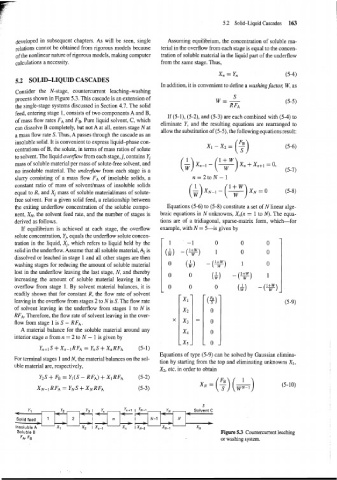
       Soluble B                                                               Figure 5.3  Countercurrent leaching
         -
        'A,  F~                                                                or washing system.

