


Page 197 - Separation process principles 2
P. 197
162  Chapter 5  Cascades and Hybrid Systems


                             Feed           Product 1                easier to  apply in  a batchwise manner. It differs from the
                                           I                         countercurrent cascade in  that  the  solvent is  divided into
                                                                     portions fed individually to each stage.
                                      Stage
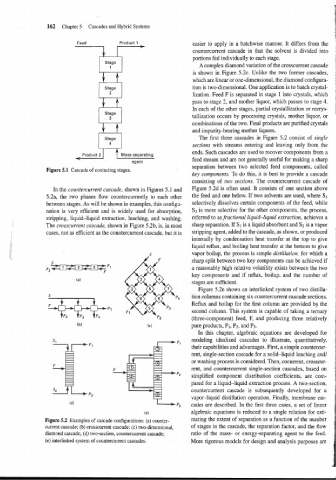
                                        1                               A complex diamond variation of the crosscurrent cascade
                                     4  t                            is shown in Figure 5.2~. Unlike the two former cascades,
                                                                     which are linear or one-dimensional, the diamond configura-
                                      Stage                          tion is two-dimensional. One application is to batch crystal-
                                        2                            lization. Feed F is separated in stage 1 into crystals, which
                                          t                          pass to stage 2, and mother liquor, which passes to stage 4.
                                                                     In each of the other stages, partial crystallization or recrys-
                                                                     tallization occurs by  processing crystals, mother liquor, or
                                                                     combinations of the two. Final products are p~~rified crystals
                                    E                                and impurity-bearing mother liquors.
                                                                        The first three cascades in Figure 5.2 consist of  single
                                      Stage
                            product 2 1     Mass-separating          sections  with  streams entering and  leaving only from the
                                                                     ends. Such cascades are used to recover components from a
                                                                     feed stream and are not generally useful for making a sharp
                                                agent
                                                                     separation between  two  selected  feed  components, called
                  Figure 5.1  Cascade of contacting stages.
                                                                     key components. To do this, it is best to provide a cascade
                                                                     consisting of  two sections.  The countercurrent cascade of
                    In the countercurrent cascade, shown in Figures 5.1 and   Figure 5.2d is often used. It consists of  one section above
                  5.2a,  the  two  phases  flow  countercurrently to  each  other   the feed and one below. If two solvents are used, where S1
                  between stages. As will be shown in examples, this configu-   selectively dissolves certain components of  the feed, while
                  ration is very  efficient and is widely  used  for absorption,   S2 is more selective for the other components, the process,
                  stripping, liquid-liquid  extraction, leaching, and  washing.   referred to as  fractional  liquid-liquid  extraction, achieves a
                  The crosscurrent cascade, shown in Figure 5.2b, is, in most   sharp separation. If S  is a liquid absorbent and Sz is a vapor
                  cases, not as efficient as the countercurrent cascade, but it is   stripping agent, added to the cascade, as shown, or produced
                                                                     internally by  condensation heat transfer at the top to  give
                                                                     liquid reflux, and boiling heat transfer at the bottom to give
                                                                     vapor boilup, the process is simple distillation, for which a
                                                                     sharp split between two key components can be achieved if
                                                                     a reasonably high relative volatility exists between the two
                                                                     key  components and  if  reflux, boilup, and  the  number of
                                                                     stages are sufficient.
                                                                       Figure 5.2e shows an interlinked system of two distilla-
                                                                     tion columns containing six countercurrent cascade sections.
                                                                     Reflux and boilup for the first column are provided by the
                                                                     second column. This system is capable of taking a ternary
                                                                     (three-component) feed, F,  and producing three  relatively
                                                                     pure products, PI, P2, and P3.
                                                                       In  this  chapter,  algebraic equations  are  developed  for
                                                                     modeling  idealized  cascades  to  illustrate,  quantitatively,
                                                                     their capabilities and advantages. First, a simple countercur-
                                                                     rent, single-section cascade for a solid-liquid  leaching and/
                                                                     or washing process is considered. Then, cocurrent, crosscur-
                                                                     rent, and countercurrent single-section cascades, based  on
                                                                     simplified  component  distribution  coefficients,  are  com-
                                                                     pared for a liquid-liquid  extraction process. A two-section,
                                                                     countercurrent  cascade  is  subsequently  developed  for  a
                                                                     vapor-liquid  distillation operation. Finally, membrane cas-
                                                                     cades are described. In the first three cases, a set of linear
                                                                     algebraic equations is reduced to a single relation for esti-
                                                    (e)
                 Figure 5.2 Examples of cascade configurations: (a) counter-   mating the extent of separation as a function of the number
                 current cascade; (b) crosscurrent cascade; (c) two-dimensional,   of stages in the cascade, the separation factor, and the flow
                 diamond cascade; (d) two-section, countercurrent cascade;   ratio of  the  mass- or energy-separating agent to the  feed.
                 (e) interlinked system of  countercurrent cascades.   More rigorous models for design and analysis purposes are

