


Page 181 - Separation process principles 2
P. 181
146  Chapter 4   Single Equilibrium Stages and Flash Calculations

                                                                      the  system temperature. When  the partial pressure of  the
                                                                      solute in the gas phase exceeds the vapor pressure of  the
                                                                      solid, desublimation occurs. At equilibrium, the vapor pres-
                                                                      sure of the species as a solid is equal to the partial pressure
                                                                      of the species as a solute in the gas phase. This is illustrated
                                                                      in the following example.


                                                                      Ortho-xylene  is partially oxidized  in the vapor phase with air to
                                                                      produce phthalic anhydride, PA, in a catalytic reactor (fixed bed or
                                                                      fluidized bed) operating at about 370°C and 780 torr. However, a
                                                                      very large excess of air must be used to keep the xylene content of
                                                                      the reactor feed below  1 mol% to avoid an explosive mixture. In
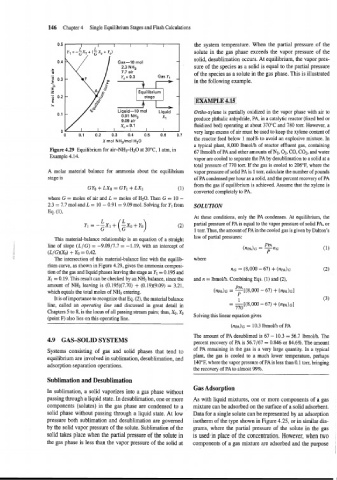
                                      X mol NH3/mol H20
                                                                      a typical  plant,  8,000 lbmolh of reactor  effluent gas, containing
                   Figure 4.29  Equilibrium for air-NH3-H20  at 20°C, 1 atm, in   67 lbmollh of PA and other amounts of N2, 02, CO, C02, and water
                   Example 4.14.
                                                                      vapor are cooled to separate the PA by desublimation to a solid at a
                                                                      total pressure of 770 torr. If the gas is cooled to 206"F, where the
                  A  molar  material  balance  for  ammonia  about  the  equilibrium   vapor pressure of solid PA is 1 ton;  calculate the number of pounds
                  stage is                                            of PA condensed per hour as a solid, and the percent recovery of PA
                                                                      from the gas if equilibrium is achieved. Assume that the xylene is
                                                                      converted completely to PA.
                  where G = moles of air and L = moles of HzO. Then G = 10 -
                  2.3 = 7.7 mol and L = 10 - 0.91 = 9.09 mol. Solving for Yl  from   SOLUTION
                  Eq. (I),
                                                                      At  these conditions,  only  the  PA  condenses. At  equilibrium,  the
                                                                      partial pressure of PA is equal to the vapor pressure of solid PA, or
                                                                      1 torr. Thus, the amount of PA in the cooled gas is given by Dalton's
                     This material-balance  relationship  is an equation of a straight   law of partial pressures:
                  line of  slope (LIG) = -9.0917.7  = -1.19,  with an intercept  of            PPA
                                                                                       (~PA)G -nG                   (1)
                                                                                             =
                  (L/G)(Xo) + Yo = 0.42.                                                        P
                     The intersection  of this material-balance line with the equilib-   where
                  rium curve, as shown in Figure 4.29, gives the ammonia composi-
                  tion of the gas and liquid phases leaving the stage as Yl  = 0.195 and
                  X1 = 0.19. This result can be checked by an NH3 balance, since the   and n = lbmollh. Combining Eqs. (1) and (2),
                  amount  of  NH3 leaving  is  (0.195)(7.70) + (0.19)(9.09)  = 3.21,
                  which equals the total moles of NH3 entering.
                     It is of importance to recognize that Eq. (2), the material balance
                  line,  called  an  operating  line  and  discussed  in  great  detail  in
                  Chapters 5 to 8, is the locus of all passing stream pairs; thus, Xo, Yo
                                                                      Solving this linear equation gives
                  (point F) also lies on this operating line.


                                                                      The amount of PA desublimed  is 67 - 10.3 = 56.7  lbmolih. The
                  4.9  GAS-SOLID  SYSTEMS                             percent recovery of PA is 56.7167 = 0.846 or 84.6%. The amount
                  Systems  consisting  of  gas  and  solid phases  that  tend  to   of  PA  remaining in the gas is a very large quantity. In a typical
                                                                      plant,  the  gas  is  cooled  to  a  much  lower  temperature,  perhaps
                  equilibrium are involved in sublimation, desublimation, and
                                                                      140°F, where the vapor pressure of PA is less than 0.1 ton;  bringing
                  adsorption separation operations.
                                                                      the recovery of PA to almost 99%.
                  Sublimation and Desublimation
                                                                      Gas Adsorption
                  In sublimation, a solid vaporizes into a gas phase without
                  passing through a liquid state. In desublimation, one or more   As with liquid mixtures, one or more components of  a gas
                  components (solutes) in the gas phase are condensed to a   mixture can be adsorbed on the surface of a solid adsorbent.
                  solid phase without passing through a liquid state. At low   Data for a single solute can be represented by an adsorption
                  pressure both  sublimation and desublimation are governed   isotherm of the type shown in Figure 4.25, or in similar dia-
                  by the solid vapor pressure of the solute. Sublimation of the   grams, where the partial pressure of  the solute in  the gas
                  solid takes place when the partial pressure of the solute in   is used.in place of the concentration. However, when two
                  the gas phase is less than the vapor pressure of the solid at   components of  a gas mixture are adsorbed and the purpose

