


Page 176 - Separation process principles 2
P. 176
4.7  Solid-Liquid  Systems  141


 t
       The total flow rate of underflow is U = 81,407 + 39,711 = 121,118   If a liquid solution of composition and temperature repre-
       kg/h By  mass  balance, the  flow rate of  overflow = 200,000 -   sented by point P is cooled along the vertical, dashed line, it
       121,118 = 78,882 kgh. These values are close to those obtained   will remain a liquid until  the line intersects the solubility
  L    by the graphical method. The percentage recovery of oil, and com-   curve at point F. If the temperature is lowered further, crys-
 /     positions of the underflow and overflow, are computed in the same   tals  of  naphthalene form and  the remaining liquid, called
 !     manner as in the graphical method.                 the mother liquor, becomes richer in benzene. For example,
                                                          when  point  G  is  reached,  pure  naphthalene  crystals  and
                                                          a mother liquor, given by  point H on solubility curve EB,
       Crystallization
                                                          coexist at equilibrium, with the composition of the solution
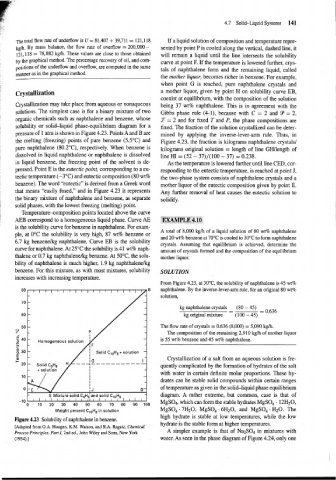
       crystallization may take place from aqueous or nonaqueous   being  37 wt%  naphthalene. This is in agreement with the
       solutions. The simplest case is for a binary mixture of two   Gibbs phase rule  (4-I), because with  C = 2  and  9 = 2,
       organic chemicals such as naphthalene and benzene, whose   3 = 2 and for fixed T and P, the phase compositions are
       solubility or solid-liquid  phase-equilibrium diagram for a   fixed. The fraction of the solution crystallized can be deter-
       pressure of 1 atm is shown in Figure 4.23. Points A and B are   mined  by  applying  the  inverse-lever-arm rule.  Thus,  in
       the melting  (freezing) points of pure benzene (5.S°C) and   Figure 4.23, the fraction is kilograms naphthalene crystals1
       pure naphthalene (80.2"C), respectively. When benzene is   kilograms original solution = length of  line GWlength of
       dissolved in liquid naphthalene or naphthalene is dissolved   line HI = (52 - 37)/(100 - 37) = 0.238.
       in  liquid benzene, the freezing point  of  the solvent is de-   As the temperature is lowered further until line CED, cor-
       pressed. Point E is the eutectic point, corresponding to a eu-   responding to the eutectic temperature, is reached at point J,
       tectic temperature (-3°C)  and eutectic composition (80 wt%   the two-phase system consists of naphthalene crystals and a
       benzene). The word "eutectic" is derived from a Greek word   mother liquor of the eutectic composition given by point E.
       that means "easily fused,"  and in Figure 4.23 it represents   Any further removal of heat causes the eutectic solution to
       the binary mixture of naphthalene and benzene, as separate   solidify.
       solid phases, with the lowest freezing (melting) point.
         Temperature-composition points located above the curve
       AEB correspond to a homogeneous liquid phase. Curve AE   EXAMPLE 4.10
       is the solubility curve for benzene in naphthalene. For exam-
                                                          A total of  8,000 kgh of  a liquid solution of  80 wt% naphthalene
       ple, at 0°C the solubility is very high, 87 wt%  benzene or
                                                          and 20 wt% benzene at 70°C is cooled to 30°C to form naphthalene
       6.7 kg  benzenekg  naphthalene. Curve EB  is the solubility   crystals. Assuming  that  equilibrium is  achieved, determine  the
       curve for naphthalene. At 25°C the solubility is 41 wt% naph-   amount of crystals formed and the composition of  the equilibrium
       thalene or 0.7 kg naphthalenekg benzene. At 50°C the solu-   mother liquor.
       bility of naphthalene is much higher, 1.9 kg naphthalenekg
       benzene. For ths mixture, as with most mixtures, solubility   SOLUTION
       increases with increasing temperature.
                                                          From Figure 4.23, at 30°C, the solubility of naphthalene is 45 wt%
                                                          naphthalene. By  the inverse-lever-arm rule, for an original 80 wt%
                                                          solution,
                                                                 kg naphthalene crystals - (80 - 45)
                                                                                  -          = 0.636
                                                                  kg original mixture   (100 - 45)

                                                          The flow rate of crystals = 0.636 (8,000) = 5,090 kgh.
                                                            The composition of  the remaining 2,910 kgh of  mother liquor
                                                          is 55 wt% benzene and 45 wt% naphthalene.


                                                            Crystallization of a salt from an aqueous solution is fre-
                                                          quently complicated by the formation of hydrates of the salt
                                                          with water in certain definite molar proportions. These hy-
                                                          drates can be stable solid compounds within certain ranges
                                                          of temperature as given in the solid-liquid  phase equilibrium
                                                          diagram. A  rather  extreme,  but  common,  case  is  that  of
                                                          MgS04, which can form the stable hydrates MgSO,  . 12H20,
                     Weight percent C,,,Hs   in  solution   MgS0,.  7H20,  MgS0,  . 6Hz0,  and  MgSO,  . H20. The
                                                          high hydrate is stable at low  temperatures, while the low
      Figure 4.23  Solubility of naphthalene in benzene.
                                                          hydrate is the stable form at higher temperatures.
       [Adapted from O.A. Hougen, K.M. Watson, and R.A. Ragatz, Chemical
                                                            A simpler example is  that  of  Na2S04 in  mixtures with
      Process Principles. Part I, 2nd ed., John Wiley and Sons, New York
      (1954).]                                            water. As seen in the phase diagram of Figure 4.24, only one

