


Page 174 - Separation process principles 2
P. 174
4.7  Solid-Liquid Systems  139

                 Solid feed, F     Overflow,  V                                                         E
                    Insoluble A      Liquid

                 Liquid

                          MIXER-SETTLER


                               I  Underflow, U >
                                Liquid   Solid
                                --
                                 B,  C   A
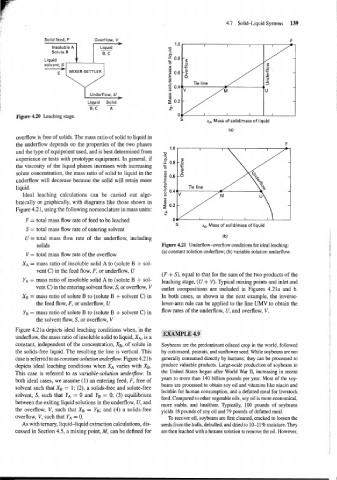
       Figure 4.20  Leaching stage.
                                                                 S        x,,   Mass of solidlmass of liquid
                                                                                  (a)
       overflow is free of solids. The mass ratio of solid to liquid in
       the underflow  depends on the properties of the two phases
       and the type of equipment used, and is best determined from
       experience or tests with prototype equipment. In general, if
       the viscosity of the liquid phases increases with increasing
       solute concentration, the mass ratio of solid to liquid in the
       underflow  will decrease because the solid will retain  more
       liquid.
         Ideal  leaching  calculations  can  be  carried  out  alge-
       braically or graphically, with diagrams like those shown in
       Figure 4.21, using the following nomenclature in mass units:
          F = total mass flow rate of feed to be leached
                                                               S        x,,   Mass of solidlmass of liquid
          S = total mass flow rate of entering solvent
          U = total  mass  flow  rate  of  the  underflow,  including
              solids                                      Figure 4.21  Underflow-overflow conditions for ideal leaching:
                                                          (a) constant solution underflow; (b) variable solution underflow.
          V = total mass flow rate of the overflow
         XA = mass ratio of insoluble solid A to (solute B + sol-
              vent C) in the feed flow, F, or underflow, U
                                                          (F + S), equal to that for the sum of the two products of the
         YA = mass ratio of insoluble solid A to (solute B + sol-   leaching stage, (U + V). Typical mixing points and inlet and
              vent C) in the entering solvent flow, S, or overflow, V   outlet  compositions  are  included  in  Figures 4.21a  and  b.
         XB = mass ratio of solute B to (solute B + solvent C) in   In both cases, as shown in the next  example, the inverse-
              the feed flow, F, or underflow, U           lever-arm rule can be applied to the line UMV to obtain the
         YB = mass ratio of solute B to (solute B + solvent C) in   flow rates of the underflow,  U, and overflow, V.
              the solvent flow, S,  or overflow, V
       Figure 4.21a depicts ideal leaching conditions when, in the
       underflow, the mass ratio of insoluble solid to liquid, XA, is a
       constant, independent of the concentration, XB, of solute in   Soybeans are the predominant oilseed crop in the world, followed
       the solids-free liquid. The resulting tie line is vertical. This   by cottonseed, peanuts, and sunflower seed. While soybeans are not
       case is referred to as constant-solution underjlow. Figure 4.2 Ib   generally consumed directly by humans; they can be processed to
       depicts ideal leaching conditions  when XA varies with XB.   produce valuable products. Large-scale production of  soybeans in
       This case is referred  to as variable-solution underflow. In   the United States began after World War  11,  increasing in recent
                                                          years to more than  140 billion pounds per year. Most of the soy-
       both ideal cases, we assume (1) an entering feed, F, free of
                                                          beans are processed to obtain soy oil and vitamins like niacin and
       solvent such that XB = 1; (2), a solids-free and solute-free
                                                          lecithin for human consumption, and a defatted meal for livestock
       solvent, S, such that  YA  = 0  and  YB  = 0; (3) equilibrium
                                                          feed. Compared to other vegetable oils, soy oil is more economical,
       between the exiting liquid solutions in the underflow, U, and
                                                          more  stable, and  healthier. Typically,  100  pounds  of  soybeans
       the overflow,  V, such that XB = YB;  and (4)  a  solids-free   yields 18 pounds of soy oil and 79 pounds of defatted meal.
       overflow, V, such that YA = 0.                       To recover oil, soybeans are first cleaned, cracked to loosen the
         As with ternary, liquid-liquid  extraction calculations, dis-   seeds from the hulls, dehulled, and dried to 10-11% moisture. They
       cussed in Section 4.5, a mixing point, M, can be defined for   are then leached with a hexane solution to remove the oil. However,

