


Page 173 - Separation process principles 2
P. 173
138  Chapter 4  Single Equilibrium Stages and Flash Calculations


                   procedure is repeated until the compositions xjl) and xj2), to   Results for isopropanol and acetone are in reasonably good agree-
                   say three or four significant digits, no longer change from   ment  at  these  relatively  dilute  conditions,  considering  that  no
                   one  iteration  to  the  next.  Multicomponent  liquid-liquid   temperature corrections were made.
                   equilibrium calculations are best carried out with a steady-
                   state simulation computer program.
                                                                      4.7  SOLID-LIQUID  SYSTEMS

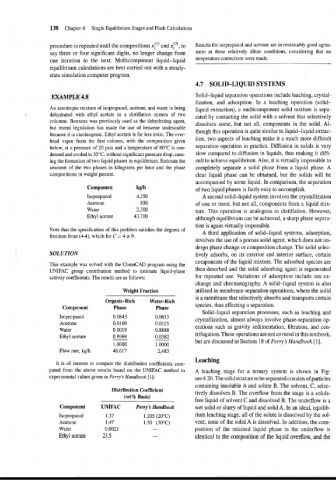
                   EXAMPLE 4.8                                        Solid-liquid  separation operations include leaching, crystal-
                                                                      lization,  and  adsorption.  In  a  leaching  operation  (solid-
                   An azeotropic mixture of isopropanol, acetone, and water is being   liquid extraction), a multicomponent solid mixture is sepa-
                   dehydrated  with  ethyl  acetate  in  a  distillation  system  of  two
                                                                      rated by contacting the solid with a solvent that selectively
                   columns. Benzene was previously used as the dehydrating agent,
                                                                      dissolves some, but  not  all, components in  the  solid. Al-
                   but  recent  legislation  has  made  the  use  of  benzene  undesirable
                                                                      though this operation is quite similar to liquid-liquid  extrac-
                   because it is carcinogenic. Ethyl acetate is far less toxic. The over-
                                                                      tion, two aspects of leaching make it a much more difficult
                   head  vapor  from  the  first  column,  with  the  composition  given
                   below, at a pressure of 20 psia and a temperature of 80°C is con-   separation operation in practice. Diffusion in solids is very
                   densed and cooled to 35"C, without significant pressure drop, caus-   slow compared to diffusion in liquids, thus making it diffi-
                   ing the formation of two liquid phases in equilibrium. Estimate the   cult to achieve equilibrium. Also, it is virtually impossible to
                   amounts of  the two phases  in kilograms  per hour and the phase   completely separate a solid phase from a  liquid phase. A
                   compositions in weight percent.                    clear liquid phase can be  obtained, but  the  solids will be
                                                                      accompanied by some liquid. In comparison, the separation
                                Component        kgh                  of two liquid phases is fairly easy to accomplish.
                                Isopropanol      4,250                   A second solid-liquid  system involves the crystallization
                                Acetone            850                of one or more, but not all, components from a liquid mix-
                                Water            2,300                ture. This operation is analogous to distillation. However,
                                Ethyl acetate    43,700
                                                                      although equilibrium can be achieved, a sharp phase separa-
                                                                      tion is again virtually impossible.
                   Note that the specification of this problem satisfies the degrees of
                                                                         A third  application of  solid-liquid  systems, adsorption,
                   freedom from (4-4), which for C = 4 is 9.
                                                                      involves the use of a porous solid agent, which does not un-
                                                                      dergo phase change or composition change. The solid selec-
                   SOLUTION                                           tively  adsorbs, on its exterior and interior surface, certain
                                                                      components of the liquid mixture. The adsorbed species are
                   This example was solved with the ChemCAD program using the
                                                                      then desorbed and the solid adsorbing agent is regenerated
                   UNIFAC  group  contribution  method  to  estimate  liquid-phase
                   activity coefficients. The results are as follows:   for repeated use.  Variations of  adsorption include ion ex-
                                                                      change and chromatography. A solid-liquid  system is also
                                             Weight Fraction          utilized in membrane-separation operations, where the solid
                                                                      is a membrane that selectively absorbs and transports certain
                                      Organic-Rich    Water-Rich
                                                                      species, thus effecting a separation.
                       Component         Phase          Phase
                                                                         Solid-liquid  separation processes, such as leaching and
                      Isopropanol        0.0843         0.0615        crystallization, almost always involve phase-separation op-
                      Acetone            0.0169         0.01 15
                                                                      erations such as gravity sedimentation, filtration, and cen-
                      Water              0.0019         0.8888
                      Ethyl acetate      0.8969         0.0382        trifugation. These operations are not covered in this textbook,
                                                                      but are discussed in Section 18 of PerryS Handbook [I].
                                         1  .oooo       1 .oooo
                      Flow rate, kgh     48,617          2,483
                                                                      Leaching
                     It  is of  interest  to compare  the  distribution  coefficients com-
                   puted  from  the  above results  based  on  the  UNIFAC  method  to   A  leaching  stage  for  a  ternary  system  is  shown  in  Fig-
                   experimental values given in Perry's Handbook [I]:
                                                                      ure 4.20. The solid mixture to be separated consists of particles
                                                                      containing insoluble A and solute B. The solvent, C, selec-
                                         Distribution Coefficient     tively dissolves B. The overflow from the stage is a solids-
                                             (wt  % Basis)
                                                                      free liquid of solvent C and dissolved B. The underflow is a
                      Component      UNIFAC      Peny 's  Handbook    wet solid or sluny of liquid and solid A. In an ideal, equilib-
                      Isopropanol      1.37         1.205 (20°C)      rium leaching stage, all of the solute is dissolved by the sol-
                      Acetone          1.47         1.50  (30°C)      vent; none of the solid A is dissolved. In addition, the com-
                      Water           0.0021           -              position of  the  retained  liquid  phase in  the  underflow  is
                      Ethyl acetate   23.5             -              identical to the composition of the liquid overflow, and the

