


Page 178 - Separation process principles 2
P. 178
4.7  Solid-Liquid  Systems  143


                                                              q~ =concentration  of adsorbate, mollunit mass of
                                                                  adsorbent
                                                              Q = volume of liquid (assumed to remain constant
                                                                  during adsorption)
                                                              S = mass of adsorbent (solute-free basis)
                                                          A material balance on the solute, assuming that the entering
                                                          adsorbent is free of solute and that adsorption equilibrium is
                                                          achieved, as  designated by  the  asterisk  superscript on  q,
 i                                       mmole
 !                   Equilibrium concentration, c,  -     gives
                                          liter
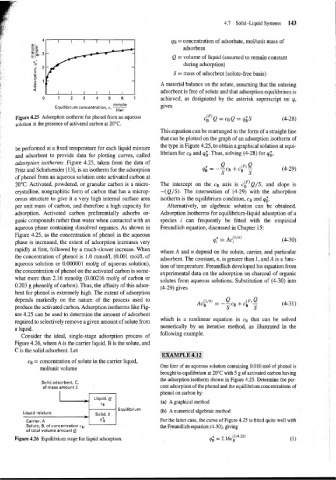
       Figure 4.25  Adsorption isotherm for phenol from an aqueous
       solution in the presence of activated carbon at 20°C.
                                                          This equation can be rearranged to the form of a straight line
                                                          that can be plotted on the graph of an adsorption isotherm of
  I
                                                          the type in Figure 4.25, to obtain a graphical solution at equi-
       be performed at a fixed temperature for each liquid mixture
                                                          librium for c~ and qi. Thus, solving (4-28) for q;,
       and  adsorbent to provide  data  for  plotting  curves, called
       adsorption  isotherms. Figure 4.25, taken  from the data of
       Fritz and Schuluender [13], is an isotherm for the adsorption
       of phenol from an aqueous solution onto activated carbon at
       20°C. Activated, powdered, or granular carbon is a micro-   The  intercept  on  the  c~ axis  is  cr)Q/S, and  slope  is
       crystalline, nongraphitic form of carbon that has a microp-   -(Q/S).  The  intersection  of  (4-29)  with  the  adsorption
       orous structure to give it a very high internal surface area   isotherm is the equilibrium condition, c~ and q;  .
       per unit mass of carbon, and therefore a high capacity for   Alternatively,  an  algebraic  solution  can  be  obtained.
       adsorption.  Activated  carbon  preferentially  adsorbs  or-   Adsorption isotherms for equilibrium-liquid adsorption of a
       ganic compounds rather than water when contacted with an   species  i  can  frequently  be  fitted  with  the  empirical   I
       aqueous phase containing dissolved organics. As shown in   Freundlich equation, discussed in Chapter 15:
       Figure 4.25, as the concentration of phenol in the aqueous
       phase is increased, the extent of  adsorption increases very
       rapidly at first, followed by a much-slower increase. When                                                    I
                                                          where A and n depend on the solute, carrier, and particular   I
       the concentration of phenol is 1.0 rnmoVL (0.001 mol/L of
                                                          adsorbent. The constant, n, is greater than 1, and A is a func-
       aqueous solution or 0.000001 moVg  of  aqueous solution),
                                                          tion of temperat~~re. Freundlich developed his equation from
       the concentration of phenol on the activated carbon is some-
                                                          experimental data on the adsorption on charcoal of  organic
       what more than 2.16 mmoVg (0.00216 mollg of carbon or
                                                          solutes from aqueous solutions. Substitution of (4-30) into
       0.203 g phenoVg of carbon). Thus, the affinity of this adsor-
                                                          (4-29) gives
       bent for phenol is extremely high. The extent of adsorption
       depends  markedly  on  the  nature  of  the  process  used  to
       produce the activated carbon. Adsorption isotherms like Fig-
       ure 4.25 can be used to determine the amount of adsorbent
                                                          which  is  a  nonlinear  equation  in  c~  that  can  be  solved
       required to selectively remove a given amount of solute from
                                                          numerically by  an  iterative method,  as  illustrated  in  the
       a liquid.
                                                          following example.
         Consider the  ideal,  single-stage  adsorption process  of
       Figure 4.26, where A is the carrier liquid, B is the solute, and
       C is the solid adsorbent. Let
                                                          EXAMPLE 4.12
           CB z concentration of solute in the carrier liquid,
                                                          One liter of an aqueous solution containing 0.010 rnol of phenol is
               moVunit volume
                                                          brought to equilibrium at 20°C with 5 g of activated carbon having
                                                          the adsorption isotherm shown in Figure 4.25. Determine the per-
                Solid adsorbent,  C,
                of mass amount S                          cent adsorption of the phenol and the equilibrium concentrations of
                                                          phenol on carbon by:
                                   Liquid, Q
                                                          (a) A graphical method
                                           Equilibrium
          Liquid mixture           Solid, S               (b)  A numerical algebraic method
           Carrier, A                                     For the latter case, the curve of Figure 4.25 is fitted quite well with
           Solute, B,  of concentration  cs,              the Freundlich equation (4-30), giving
           of total volume amount Q
       Figure 4.26  Equilibrium stage for liquid adsorption.

