


Page 182 - Separation process principles 2
P. 182
4.10  Multiphase Systems  147


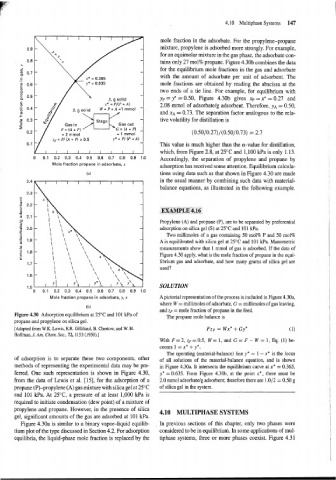
                                                          mole fraction  in the adsorbate.  For the propylene-propane
                                                          mixture, propylene is adsorbed more strongly. For example,
                                                          for an equimolar mixture in the gas phase, the adsorbate con-
                                                   -
                                                          tains only 27 mol% propane. Figure 4.30b combines the data
                                                   -      for the equilibrium mole fractions in the gas and adsorbate
                                                          with  the  amount  of  adsorbate per  unit  of  adsorbent.  The
                                                   -      mole fractions  are obtained by reading the abscissa  at the
                                                          two ends of  a  tie line.  For  example, for equilibrium with
                                                          yp = y*  = 0.50,  Figure  4.30b  gives  xp = 3E*  = 0.27  and
                                                          2.08 mmol of adsorbatelg adsorbent. Therefore, y~  = 0.50,
                                                          and XA = 0.73. The separation factor analogous to the rela-
                                                          tive volatility for distillation is

                       = 2 mmol            = I mmol
                    ZF = PI  (A + P) = 0.5   y*=Pl(P+A)  -
                                                          This value is much higher than the a-value for distillation,
                                                          which, from Figure 2.8, at 25°C and 1,100 kPa is only 1.13.
             0   0.1   0.2   0.3   0.4   0.5   0.6   0.7   0.8   0.9  1.0   Accordingly,  the  separation  of  propylene  and  propane  by
                    Mole fraction  propane in adsorbate, x
                                                          adsorption has received some attention. Equilibrium calcula-
                                (a)                       tions using data such as that shown in Figure 4.30 are made
           2.4                                            in the usual manner by combining such data with material-
                                                          balance  equations,  as illustrated  in the following example.


                                                          Propylene (A) and propane (P), are to be separated by preferential
                                                          adsorption on silica gel (S) at 25°C and 101 Ha.
                                                            Two millimoles of  a gas containing 50 mol% P and 50 mol%
                                                          A is equilibrated with silica gel at 25OC and 101 Wa. Manometric
                                                          measurements show that  1 mmol of gas is adsorbed. If the data of
                                                          Figure 4.30 apply, what is the mole fraction of propane in the equi-
                                                          librium gas and adsorbate, and how  many grams of  silica gel are
                                                          used?


           1.5                                            SOLUTZON
             0   0.1   0.2   0.3   0.4   0.5   0.6   0.7   0.8   0.9  1.0
                   Mole fraction propane in adsorbate, y,  x   A pictorial representation of the process is included in Figure 4.30a,
                                                          where W = millimoles of adsorbate, G = millimoles of gas leaving,
                                (b)
                                                          and ZF = mole fraction of propane in the feed.
      Figure 4.30  Adsorption equilibrium at 25OC and 101 Wa of
                                                            The propane mole balance is
      propane and propylene on silica gel.
      [Adapted from W.K. Lewis, E.R. Gilliland, B. Chertow, and W. H.
      Hoffman, J. Am. Chem. Soc., 72,1153 (1950).]
                                                          With F = 2, ZF = 0.5, W = 1, and  G  = F - W = 1, Eq. (1) be-
                                                          comes 1 = x* + y*.
                                                            The operating (material-balance) line y* = 1 - n* is the locus
      of  adsorption  is to  separate  these  two  components, other   of  all  solutions  of  the  material-balance equation, and  is  shown
      methods of representing  the experimental data may be pre-   in Figure 4.30a. It intersects the equilibrium curve at x* = 0.365,
      ferred.  One  such representation  is  shown in  Figure 4.30,   y*  = 0.635. From  Figure  4.30b, at  the point x*, there  must be
      from the data of  Lewis et al.  [15], for the  adsorption of  a   2.0 mmol adsorbatelg adsorbent; therefore there are 1.012 = 0.50 g
      propane (P)-propylene  (A) gas mixture with silica gel at 25OC   of silica gel in the system.
      and  101 kPa. At  25"C,  a pressure of  at least  1,000 kPa is
      required to initiate condensation (dew point) of a mixture of
      propylene and propane. However, in the presence  of silica   4.10  MULTIPHASE SYSTEMS
      gel, significant amounts of the gas are adsorbed at 101 kPa.
         Figure 4.30a is similar to a binary vapor-liquid  equilib-   In previous  sections of  this  chapter, only two phases  were
      rium plot of the type discussed in Section 4.2. For adsorption   considered to be in equilibrium. In some applications of mul-
      equilibria, the liquid-phase mole fraction is replaced by the   tiphase systems, three or more phases  coexist. Figure 4.31

