


Page 180 - Separation process principles 2
P. 180
4.8  Gas-Liquid  Systems  145


                 mole fraction  of  the gas (solute) in  the  liquid   The corresponding ratio of dissolved Con to water is
       when  the  pressure  of  the  gas  is  1  atm.  The  curves  of
                                                                 5.7  10-3
       Figure 4.27 can be used to estimate the solubility in water at      = 5.73 x   mol CO2/mol H20
                                                                1 - 5.7 x
       other pressures and for mixtures of gases by applying Henry's
                                          - -
       law  with  the partial  pressure  of  the  solute,   that   The total number of moles of C02 to be absorbed is
       mole-fraction solubilities are low and no chemical reactions
                                                                      1,000 ft3     1,000
       occur among the gas species or with water. Henry's law, dis-               -      = 2.79 lbmol
                                                                                  -
       cussed briefly in Chapter 2 and given in Table 2.3, is rewrit-   359 ft3/lbmol (at STP)   359
       ten for use with Figure 4.27 as
                                                          or (2.79)(44)(0.454) = 55.73 kg.
                                                          Assuming all the absorbed C02 is vented at the mountain top, the
                                                 (4-32)
                                                          number  of  moles  of  water  required  is  2.79/(5.73 x   =
                                                          458 lbmol = 8,730 lb = 3,963 kg.
       where Hi = Henry's law constant, atm.
                                                                      ~
                                                                 ~
                                                           ~
                                                                           '
                                                                                ~
         For gases with a high solubility, such as   H  ~  If one corrects for the fact that the pressure on top of the mountain
                                                          is 101 kPa, so that not all of the C02 is vented, 4,446 kg (9,810 lb)
       law may not be applicable, even at low partial pressures. In
                                                          of water are required.
       that case, experimental data for the actual conditions of pres-
       sure and temperature  are necessary  as in Example 4.14.  In
       either case, calculations of equilibrium conditions are made
                                                          EXAMPLE 4.14
       in the manner illustrated in previous sections of this chapter
      by  combining  material  balances  with  equilibrium  relation-   The partial pressure of  ammonia  (A) in  air-ammonia  mixtures
       ships or data. The following two examples illustrate single-   in  equilibrium with their aqueous solutions at 20°C is given in
       stage, gas-liquid equilibria calculation methods.   Table 4.7. Using these data, and neglecting the vapor pressure of
                                                          water and the solubility of  air in water, construct an equilibrium
                                                          diagram at 101 kPa using mole ratios YA = rnol NHs/mol air, and
       EXAMPLE 4.13                                       XA = rnol NH3/mol H20 as coordinates. Henceforth, the subscript
                                                          A is dropped. If  10 rnol of  gas, of  composition Y = 0.3, are con-
      An ammonia plant, located at the base of a 300-ft (91.44-m)-high   tacted with  10 rnol  of  a solution of  composition X = 0.1, what
      mountain, employs a unique absorption system for disposing of   are the compositions of  the resulting phases at equilibrium? The
      by-product COz. The COz is absorbed in water at a C02 partial
                                                          process is assumed to be isothermal and at atmospheric pressure.
      pressure of  10 psi (68.8 kPa) above that required to lift water to the
      top of  the mountain. The C02 is then vented to the atmosphere at
                                                          SOLUTION
       the top of  the mountain, the water being recirculated as shown in
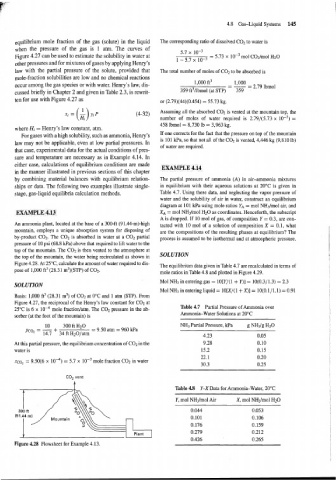
      Figure 4.28. At 25"C, calculate the amount of water required to dis-
                                                          The equilibrium data given in Table 4.7 are recalculated in terms of
      pose of  1,000 ft3 (28.31 m3)(S~P) of C02.
                                                          mole ratios in Table 4.8 and plotted in Figure 4.29.
                                                          Mol NH3 in entering gas = 10[Y/(1 + Y)] = 10(0.3/1.3) = 2.3
      SOLUTION
                                                          Mol NH3 in entering liquid = 10[X/(1 + X)] = 10(0.1/1.1) = 0.91
      Basis:  1,000 ft3 (28.31 m3) of  C02 at 0°C and 1 atrn (STP). From
      Figure 4.27, the reciprocal of the Henry's law constant for CO2 at
      25°C is 6 x   mole fractionlatm. The C02 pressure in the ab-   Table 4.7  Partial Pressure of Ammonia over
                                                                 Ammonia-Water  Solutions at 20°C
      sorber (at the foot of the mountain) is
                 10
          Pcoz = - +    300ftH20   = 9.50 atm = 960 kPa          NH3 Partial Pressure, kPa   g NH3/g H20
                 14.7   34 ft H20/atm                                    4.23
                                                                                            0.05
      At this partial pressure, the equilibrium concentration of COz in the
      water is
      xco2 = 9.50(6 x   = 5.7 x   mole fraction C02 in water


                         COP vent
                                                               Table 4.8  Y-X  Data for Ammonia-Water,  20°C

                                                               Y,  mol NH31mol Air   X, mol NH3/mol H20
                                                                     0.044                0.053
                                                                     0.101                0.106
                                                                     0.176                0.159
                                                                     0.279                0.212
                                                 Plant
                                                                     0.426                0.265
      Figure 4.28  Flowsheet for Example 4.13.

