


Page 175 - Separation process principles 2
P. 175
140  Chapter 4  Single Equilibrium Stages and Flash Calc~~lations


                   before leaching, the soybeans are flaked to reduce the time required   5.0   I   I   I   I
                   for mass transfer of the oil out of the bean and into hexane. Fol-   4.5  -                      -
                   lowing leaching, the hexane in the overflow is separated from the                                 1 F
                                                                       '0
                   soy oil and recovered for recycle by evaporation, while the under-   '5  4.0 -
                                                                       u
                   flow  is  treated  to  remove  residual  hexane  and  toasted  with   '-
                                                                         3.5 -
                   high-temperature  air to produce defatted meal. Modem soybean-
                   extraction plants crush up to 3,000 tons of soybeans per day. This   ! 3.0 -
                                                                       E
                   example is concerned with just the leaching step.   \                                            -
                                                                       2 2.5 -
                     Oil is to be leached from 100,000 kgh of soybean flakes, con-   g
                   taining  19% by weight oil, in a single stage by  100,000 kgh of  a   ; -
                                                                         2.0
                   hexane solvent. Experimental data indicate that the oil content of
                   the flakes will be reduced to 0.5 wt%. For the type of equipment to   2
                   be used, the expected contents of the underflows is as follows:
                                                                                                                    -
                   p, Mass fraction of   0.68   0.67   0.65   0.62   0.58   0.53
                    solids in underflow                                                     I  Overflow     I
                                                                           0       0.2     0.4     0.6     0.8      1
                   Mass ratio of    0.0   0.2   0.4   0.6   0.8   1.0
                                                                                     X,,  Mass solute/mass of  liquid
                    solute in underflow
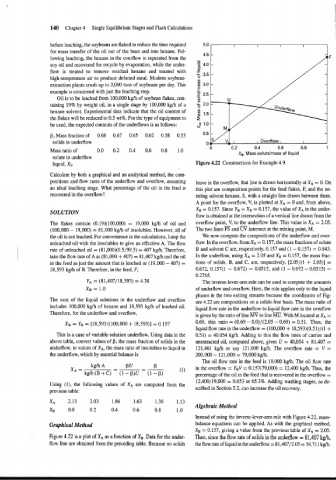
                    liquid, XB                                        Figure 4.22  Constructions for Example 4.9.
                   Calculate by both a graphical and an analytical method, the com-
                   positions  and flow rates of  the underflow and overflow, assuming   leave in the overflow, that line is drawn horizontally at XA = 0. On
                   an ideal leaching  stage. What percentage  of  the oil in the feed is   this plot are composition points for the feed flakes, F,  and the en-
                   recovered in the overflow?                         tering solvent hexane, S, with a straight line drawn between them.
                                                                      A point for the overflow, V,  is plotted at XA = 0 and, from above,
                                                                      XB = 0.157. Since YB = XB = 0.157, the value of XA in the under-
                   SOLUTION
                                                                      flow is obtained at the intersection of a vertical line drawn from the
                   The  flakes  contain  (0.19)(100,000) =  19,000  kgh  of  oil  and   overflow point, V,  to the underflow line. This value is XA = 2.05.
                   (100,000 - 19,000) = 81,000 kgh of insolubles. However, all of   The two lines % and   intersect at the mixing point, M.
                   the oil is not leached. For convenience in the calculations, lump the   We now compute the compositions of the underflow and over-
                   unleached oil with the insolubles to give an effective A. The flow   flow. In the overflow, from XB = 0.157, the mass fractions of solute
        I          rate of unleached oil = (81,000)(0.5/99.5) = 407 kgh. Therefore,   B and solvent C are, respectively, 0.157 and (1 - 0.157) = 0.843.
                   take the flow rate of A as (8 1,000 + 407) = 8 1,407 kgh and the oil   In the underflow, using XA = 2.05 and XB = 0.157, the mass frac-
                   in the feed as just the amount that is leached or (19,000 - 407) =   tions of  solids, B, and C, are, respectively, [2.05/(1 + 2.05)] =
                   18,593 kgh of B. Therefore, in the feed, F,        0.672, 0.157(1 - 0.672) = 0.0515, and  (1 - 0.672 - 0.0515) =
                                                                      0.2765.
                                                                         The inverse-lever-arm rule can be used to compute the amounts
                                                                      of underflow and overflow. Here, the rule applies only to the liquid
                                                                      phases in the two exiting streams because the coordinates of Fig-
                   The  sum  of  the  liquid  solutions  in  the  underflow  and  overflow
                                                                      ure 4.22 are compositions on a solids-free basis. The mass ratio of
                   includes  100,000 kgh of  hexane and  18,593 kgh of leached oil.
                                                                      liquid flow rate in the underflow to liquid flow rate in the overflow
                   Therefore, for the underflow and overflow,
                                                                      is given by the ratio of line   to line MU. With M located at XA =
                                                                      0.69,  this  ratio = (0.69 - 0.0)/(2.05 - 0.69) = 0.5 1.  Thus,  the
                                                                      liquid flow rate in the underflow = (100,000 + 18,593)(0.5 1)/(1 +
                     This is a case of variable-solution underflow. Using data in the   0.51) = 40,054 kgh. Adding to this the flow rates of  carrier and
                   above table, convert values of P, the mass fraction of solids in the   unextracted oil, computed above, gives  U = 40,054 + 81,407 =
                   underflow, to values of XA, the mass ratio of insolubles to liquid in   121,461  kgh or  say  121,000  kgh.  The  overflow  rate  = V =
                   the underflow, which by material balance is        200,000 - 121,000 = 79,000 kgh.
                                                                         The oil flow rate in the feed is  19,000 kgh. The oil flow rate
                                 kgh A        PU        P
                          XA =                                        in the overflow = YBV = 0.157(79,000) = 12,400 kgh. Thus, the
                               kgh (B +C)   (1 - P)U   (L-P)     (1)   percentage of the oil in the feed that is recovered in the overflow =
                                                                      12,400/19,000 = 0.653 or 65.3%. Adding washing stages, as de-
                   Using  (I),  the  following  values  of  XA are  computed  from  the
                                                                      scribed in Section 5.2, can increase the oil recovery.
                   previous table:
                   XA    2.13    2.03    1.86   1.63    1.38    1.13
                                                                      Algebraic Method
                   XB    0.0     0.2     0.4    0.6     0.8     1 .O
                                                                      Instead of using the inverse-lever-arm rule with Figure 4.22, mass-
                   Graphical Method                                   balance equations can be applied. As with the graphical  method,
                                                                      XB = 0.157, giving a value from the previous table of XA = 2.05.
                   Figure 4.22 is a plot of XA as a function of XB. Data for the under-   Then, since the flow rate of solids in the underflow = 81,407 kglh,
                   flow line are obtained from the preceding table. Because no solids   the flow rate of liquid in the underflow = 8 1,40712.05 = 39,7 11 kglh.

