


Page 170 - Separation process principles 2
P. 170
Water
                                                                                                       (A)
                                                              Mass fraction furfural
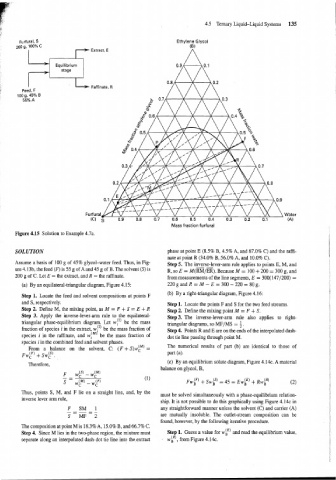
       Figure 4.15  Solution to Example 4.7a.


       SOLUTION                                             phase at point E (8.5% B, 4.5% A, and 87.0% C) and the raffi-
                                                            nate at point R (34.0% B, 56.0% A, and 10.0% C).
       Assume a basis of  100 g of 45% glycol-water  feed. Thus, in Fig-   Step 5.  The inverse-lever-arm rule applies to points E, M, and
                                                                      --
       ure 4.13b, the feed (F) is 55 g of A and 45 g of B. The solvent (S) is   R, so E = M(RM/ER). Because M = 100 + 200 = 300 g, and
       200 g of C. Let E = the extract, and R = the raffinate.   from measurements of the line segments, E = 300(147/200) =
         (a)  By an equilateral-triangular diagram, Figure 4.15:   220gandR = M-  E =300-220=80g.
                                                            (b)  By a right-triangular diagram, Figure 4.16:
         Step 1.  Locate the feed and solvent compositions at points F
         and S, respectively.                               Step 1.  Locate the points F and S for the two feed streams.
         Step 2.  Define M, the mixing point, as M = F + S = E + R   Step 2.  Define the mixing point M = F + S.
         Step 3.  Apply  the  inverse-lever-arm  rule  to  the  equilateral-   Step3.  The  inverse-lever-arm  rule  also  applies  to  right-
         triangular phase-equilibrium diagram.  Let  wi(')  be  the  mass   triangular diagrams, so MF/MS = ;.
         fraction of species i in the extract, w!')  be the mass fraction of   Step 4.  Points R and E are on the ends of the interpolated dash-
         species i  in  the  raffinate,  and  wjMi  be  the  mass  fraction  of   dot tie line passing through point M.
         species i in the combined feed and solvent phases.
                                                            The  numerical  results  of  part  (b)  are  identical  to  those  of
           From  a  balance  on  the  solvent,  C:  (F  + s)w&*)  =
         FW~) + SW:).                                       Part (a).
                                                            (c)  By an equilibrium solute diagram, Figure 4.14~. A material
           Therefore,
                                                          balance on glycol, B,


         Thus, points  S, M,  and  F lie  on  a  straight line, and, by  the
                                                          must be solved simultaneously with a phase-equilibrium relation-
         inverse lever arm rule,
                                                          ship. It is not possible to do this graphically using Figure 4.14~ in
                                                          any straightforward manner unless the solvent (C) and carrier (A)
                                                          are  mutually  insoluble.  The  outlet-stream composition  can  be
                                                          found, however, by the following iterative procedure.
         The composition at point M is 18.3% A, 15.0% B, and 66.7% C.
         Step 4.  Since M lies in the two-phase region, the mixture must   Step 1.  Guess a value for wr) and read the equilibrium value,
         separate along an interpolated dash-dot tie line into the extract   wr), from Figure 4.14~.

