


Page 166 - Separation process principles 2
P. 166
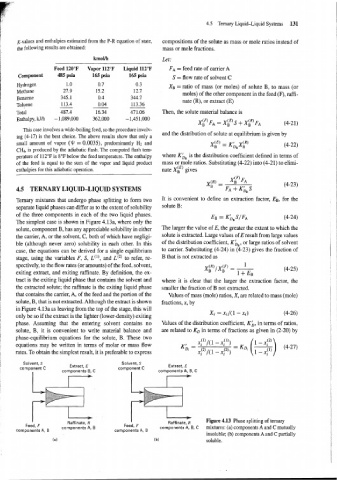
4.5  Ternary Liquid-Liquid  Systems  131


              and
       ~-~~lues enthalpies estimated from the P-R equation of state,   compositions of the solute as mass or mole ratios instead of
       the following results are obtained:                mass or mole fractions.
                                  krnolh                  Let:

                    Feed 120°F   Vapor 112°F   Liquid 112°F   FA = feed rate of carrier A
        Component     485 psia    165 psia     165 psia       S = flow rate of solvent C
       Hydrogen          1 .O       0.7
                                                 0.3         XB = ratio of  mass (or moles) of  solute B, to mass (or
       Methane          27.9       15.2
                                                12.7              moles) of the other component in the feed (F), raffi-
       Benzene         345.1        0.4        344.7              nate (R), or extract (E)
                       113.4
       Toluene        -             0.04        113.36
       Total           487.4       16.34       47 1.06    Then, the solute material balance is
       Enthalpy, kT/h   - 1,089,000   362,000   - 1,45 1,000
                                                                       xF) F*  = xF) s + xF) FA      (4-21)
         This case involves a wide-boiling feed, so the procedure involv-
                                                          and the distribution of solute at equilibrium is given by
       ing (4-17) is the best choice. The above results show that only a
       small  amount  of  vapor  (* = 0.0035), predominantly  H2  and      xp) = KbBxF)              (4-22)
       CHc is produced by the adiabatic flash. The computed flash tem-
       perature of  112°F is 8°F below the feed temperature. The enthalpy   where KbB is the distribution coefficient defined in terms of
       of  the feed is equal to the  sum of  the  vapor and liquid product   mass or mole ratios. Substituting (4-22) into (4-21) to elimi-
       enthalpies for this adiabatic operation.           nate XB (El gives


       4.5  TERNARY LIQUID-LIQUID  SYSTEMS

       Temary mixtures that undergo phase splitting to form two   It is convenient to define an extraction factor, EB, for the
       separate liquid phases can differ as to the extent of sol~~bility   solute B:
       of  the three components in  each of  the two liquid phases.
       The simplest case is shown in Figure 4.13a, where only the
       solute, component B, has any appreciable solubility in either   The larger the value of E, the greater the extent to which the
       the carrier, A, or the solvent, C, both of which have negligi-   solute is extracted. Large values of E result from large values
       ble  (although never  zero) solubility in  each other. In  this   of the distribution coefficient, KbB, or large ratios of solvent
       case, the equations can be derived for a single equilibrium   to carrier. Substituting (4-24) in (4-23) gives the fraction of
       stage, using  the variables F, S, L('), and L(*) to refer, re-   B that is not extracted as
       spectively, to the flow rates (or amounts) of the feed, solvent,
       exiting extract, and exiting raffinate. By definilion, the ex-
       tract is the exiting liquid phase that contains the solvent and   where  it  is clear that  the  larger the extraction factor, the
       the extracted solute; the raffinate is the exiting liquid phase   smaller the fraction of B not extracted.
       that contains the carrier, A, of the feed and the portion of the   Values of mass (mole) ratios, X, are related to mass (mole)
       solute, B, that is not extracted. Although the extract is shown   fractions, x, by
       in Figure 4.13a as leaving from the top of the stage, this will
       only be so if the extract is the lighter (lower-density) exiting
       phase.  Assuming  that  the  entering  solvent  contains  no   Values of the distribution coefficient, Kb, in terms of ratios,
       solute, B,  it  is  convenient to  write  material  balance  and   are related to KD in terms of fractions as given in (2-20) by
       phase-equilibrium equations for  the  solute, B.  These  two
       equations may be  written in  terms of  molar or mass flow
       rates. To obtain the simplest result, it is preferable to express

         Solvent, S                         Solvent, S
                          Extract, E
                                                             Extract, E
        component C    components B,  C    component C   components A,  B,  C
             I
                                               I


                                                                          Figure
             I                                 I  - 4.13  Phase splitting of ternary
                         Raffinate, R
          Feed, F      components A,  B      Feed, F      components A,  B,  C   mixtures: (a) components A and C mutually
       components A,  B                   components A,  B
                                                                          insoluble; (b) components A and C partially
                                                        (b)               soluble.

